[ News and Blog ]
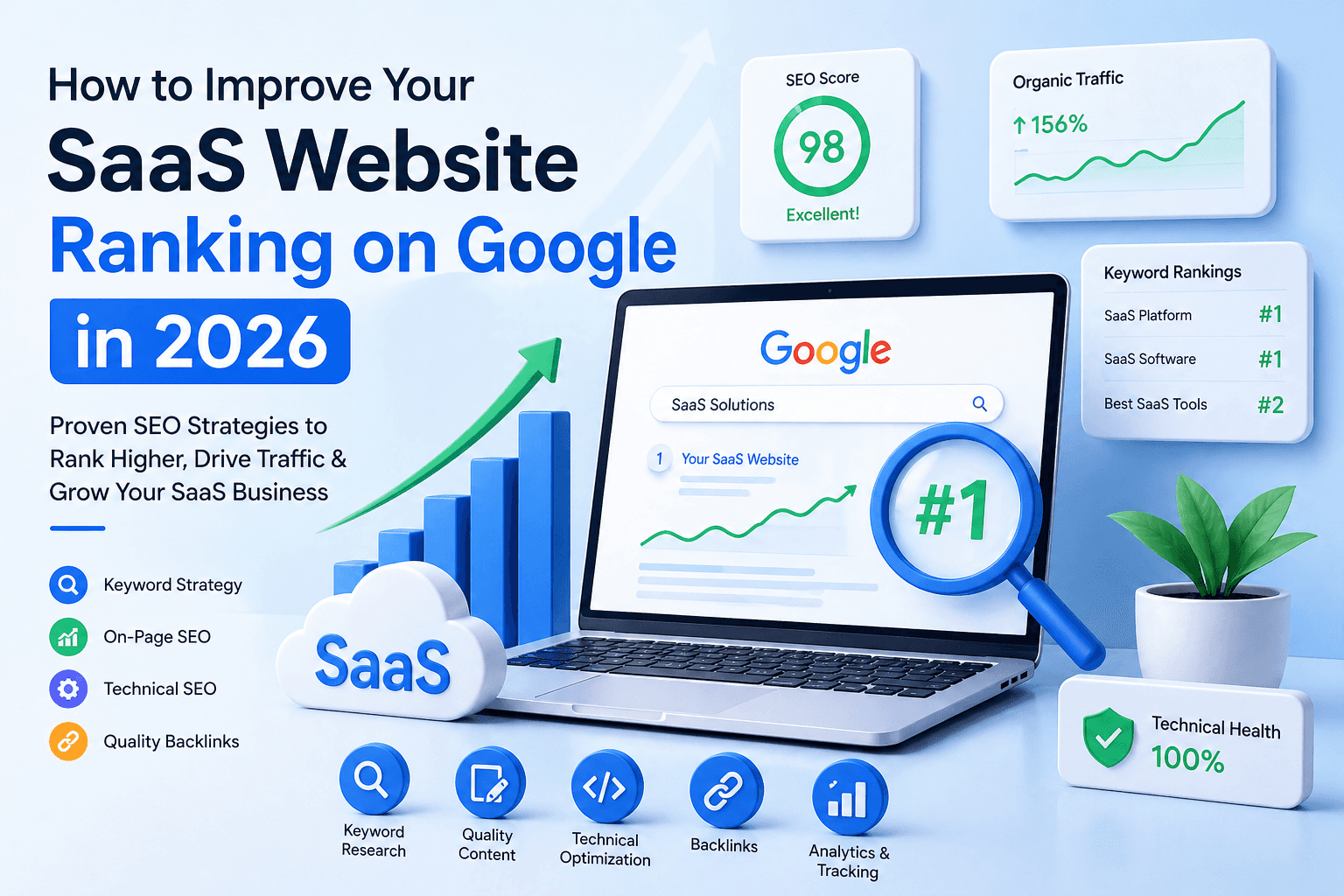
How to Improve Your SaaS Website Ranking on Google in 2026

Kartik Shah
Digital Marketing Specialist
Introduction: The Evolution of Search in 2026
If you are a SaaS founder or marketing manager in 2026, you already know the landscape has shifted. The days of launching a B2B SaaS, throwing together a few 500-word blog posts with high search volumes, and watching demo requests roll in are completely over.
Google Search has undergone a massive transformation. With the full integration of AI search, Google AI Overviews, conversational search, and the normalization of zero-click results, users are getting their answers faster and without leaving the search engine results page (SERP).
For software companies, this means SaaS SEO in 2026 is more competitive—and more complex—than ever before. Traditional SEO alone is no longer enough. If your strategy relies strictly on keyword density and basic backlinks, you are likely losing market share to competitors who have adapted to AI-driven algorithms. To improve SaaS website ranking today, you need a holistic approach that blends technical excellence, topical authority, and product-led content.
What Makes SaaS SEO Different?
Ranking a SaaS website is fundamentally different from ranking an e-commerce store or a local business. B2B software involves complex buying journeys, high customer acquisition costs (CAC), and multiple stakeholders.
Here is what makes SaaS SEO unique:
Long Sales Cycles: Enterprise software isn't an impulse buy. Users spend weeks or months researching, meaning you need content that nurtures them at every stage.
High Competition Keywords: The cost-per-click (CPC) for software keywords is astronomical, driving fierce competition in organic search.
Product-Led Search Intent: SaaS buyers search for solutions to specific operational problems.
Need for Topical Authority: Google wants to rank niche experts. A CRM company cannot just write about general business tips; they must dominate the entire conversation around customer relationship management.
Importance of Trust: B2B buyers need to know your software is secure, reliable, and well-reviewed before committing to a contract.
Examples of SaaS Search Intent:
Informational: "How to improve employee retention"
Consideration: "Project management software for startups" or "Best HR SaaS platforms"
Transactional: "AI SEO tools" or "Best CRM software"
Top SaaS SEO Ranking Factors in 2026
To win the SERPs and drive qualified product-led growth, you must align your strategy with modern ranking signals. Here are the top factors to master.
1. AI Search Optimization (AEO + GEO)
The biggest shift in Google ranking tips for SaaS involves optimizing for AI. This is divided into two main disciplines: Answer Engine Optimization (AEO) and Generative Engine Optimization (GEO).
Answer Engine Optimization (AEO): This focuses on formatting your content to be the definitive, quick answer for voice search and smart assistants. It relies on concise definitions and clear data.
Generative Engine Optimization (GEO): This focuses on ensuring your brand is cited and synthesized by generative AI search engines. It requires publishing unique insights, proprietary data, and highly authoritative thought leadership.
To optimize for AI-generated search results, your content structure must be machine-readable. Use the inverted pyramid method: answer the conversational query immediately at the top of the section, then expand with deep, entity-based SEO details below. Ensure your brand is recognized as an "entity" across the web so AI engines naturally associate your software with your target category.
2. Build Topical Authority
Google no longer ranks individual pages in a vacuum; it ranks authoritative domains. To establish topical authority, you must build comprehensive category-based content hubs.
Content Clusters: Group related content together.
Pillar Pages: Create an ultimate guide on a broad topic (e.g., "The Ultimate Guide to Email Marketing").
Semantic SEO: Cover all subtopics, questions, and related entities that a true expert would discuss.
Internal Linking Strategy: Connect your cluster pages back to your pillar page to pass link equity and topical relevance.
Example of a SaaS Topic Cluster:
If you sell helpdesk software, your pillar page might be "Customer Support Strategies." Your cluster pages would include "How to Handle Angry Customers," "Live Chat vs Email Support," and "Best Helpdesk Metrics to Track," all linking back to the main pillar and your product pages.
3. High-Intent Keyword Research
Traffic without conversions is a vanity metric. Successful SaaS SEO strategies prioritize intent over volume.
Funnel Stage | Intent Type | Keyword Example |
TOFU (Top) | Informational | "How to manage remote teams" |
MOFU (Middle) | Consideration | "Best accounting software for startups" |
BOFU (Bottom) | Commercial/Transactional | "HubSpot vs Salesforce" or "Slack alternative" |
Focus heavily on commercial intent keywords, comparison keywords, and problem-solving long-tail SaaS keywords. Buyers searching for "alternatives" or "vs" are usually at the end of their buying journey and ready to convert.
4. Create Helpful Product-Led Content
Product-led SEO is the practice of weaving your software directly into the narrative of your content as the solution to the searcher's problem.
Essential SaaS Page Types:
Use Case Pages: Explain how specific roles (e.g., "For Marketers") use your tool.
Industry Pages: Tailor the messaging for specific sectors (e.g., "Healthcare CRM").
Comparison Pages: Create honest, objective pages comparing your tool to competitors.
Integration Pages: Rank for terms like "Shopify integration" if your software connects to popular platforms.
Product-led SaaS content marketing works because it bridges the gap between educational reading and software demonstration.
5. Optimize for Google AI Overviews
Google’s AI Overviews dominate the top of the SERP in 2026. To ensure your SaaS is featured here, you must optimize your content structure specifically for AI extraction.
Structured Content: Use bullet points, numbered lists, and bolded terms.
FAQ Optimization: Anticipate exactly what your users are asking and provide direct, factual answers.
Direct Answer Formatting: Avoid fluff. Get straight to the point.
Clear Headings: Use descriptive H2 and H3 tags that double as search queries.
6. Technical SEO for SaaS Websites
You cannot build a great content strategy on a broken foundation. SaaS technical SEO requires rigorous attention to detail, especially since many SaaS platforms are built on JavaScript frameworks (like React or Vue) that can cause indexing issues.
Core Web Vitals & Site Speed: B2B buyers will bounce if your site is slow. Optimize images and reduce script payloads.
Mobile-First Indexing: Even if your software is desktop-only, Google indexes your site based on its mobile version. Ensure perfect mobile usability.
Crawlability & Indexation Management: Keep marketing pages separate from the actual app login portal. Use a clean XML sitemap to guide crawlers.
Clean Site Architecture: Ensure a user can reach any page on your marketing site within three clicks from the homepage.
7. EEAT Optimization
In 2026, Google heavily relies on Experience, Expertise, Authoritativeness, and Trustworthiness (EEAT) to combat the flood of AI-generated spam.
Experience & Expertise: Show real-world expertise. Content should be written or reviewed by actual industry veterans.
Author Profiles: Include detailed bios for your authors, linking out to their LinkedIn profiles and other published works.
Trust Signals: Embed customer reviews (from G2, Capterra, or Trustpilot), display security badges (SOC 2 compliance), and highlight case studies.
Digital PR & Brand Mentions: Get your SaaS founders interviewed on industry podcasts and quoted in major publications.
8. Link Building in 2026
Traditional link building (like paying for guest posts on generic blogs) is highly penalized. Modern link building is about earning placements through value.
SaaS Statistics Pages: Curate industry data. Journalists and AI engines love citing statistics.
Research Reports: Publish proprietary data gathered from your user base.
Digital PR: Use data-driven stories to pitch journalists.
Partnership Backlinks: Exchange links with non-competing SaaS companies that share your target audience.
9. Conversion-Focused SEO
SEO + CRO (Conversion Rate Optimization) alignment is non-negotiable. Ranking #1 means nothing if the user doesn't sign up.
User Intent Optimization: Ensure the page actually solves the user's problem before pitching the product.
CTA Placement: Use contextual Call-to-Actions. Don't just say "Sign Up." Use "Start Your Free Trial" or "Calculate Your ROI."
Demo Landing Pages: Ensure bottom-of-funnel pages have frictionless, high-converting lead capture forms.
Common SaaS SEO Mistakes to Avoid
Even the best SaaS teams make critical errors. Keep an eye out for these growth-killers:
Publishing Thin AI-Generated Content: Pumping out hundreds of unedited AI articles will tank your domain authority. Google filters out unhelpful, generic content.
Ignoring Search Intent: Trying to rank a transactional landing page for an informational blog query (or vice versa) will result in high bounce rates and lost rankings.
Weak Internal Linking: Leaving high-value pages orphaned means they won't receive link equity.
Creating Content Without Product Alignment: If your blog generates 100,000 visitors but has zero overlap with what your software actually does, you are wasting resources.
Future of SaaS SEO Beyond 2026
As we look further ahead, the AI SEO strategies we use today will evolve into fully AI-first search ecosystems.
Personalized Search: Search results will become hyper-personalized based on the user's company size, tech stack, and role.
Multimodal Search: Users will increasingly search using a combination of images, voice, and text.
Human-First Content Strategies: As AI commoditizes basic information, highly opinionated, human-led thought leadership will become the ultimate differentiator for B2B SaaS SEO.
Conclusion
Improving your SaaS website ranking on Google in 2026 requires shifting away from outdated keyword hacks and embracing a comprehensive, authority-driven approach. By mastering AEO and GEO, publishing highly relevant product-led content, and maintaining flawless technical foundations, your brand can capture high-intent traffic in an AI-first world.
Stop chasing algorithms and start optimizing for the modern B2B buyer. Invest in deep topical authority, prioritize conversion-focused intent, and build trust signals that prove your software is the definitive solution in your industry.
FAQs
1. How long does it take for SaaS SEO to show results in 2026?
Due to increased competition and Google's emphasis on domain authority and EEAT, it typically takes 6 to 9 months of consistent effort to see significant ROI from a new SaaS SEO campaign.
2. Should B2B SaaS companies focus more on SEO or paid ads?
Both are essential. Paid ads (PPC) are great for immediate bottom-of-funnel lead generation and testing messaging. SEO is a long-term investment that lowers your overall Customer Acquisition Cost (CAC) over time and builds compounding, sustainable traffic.
3. What is the difference between AEO and GEO?
AEO (Answer Engine Optimization) focuses on structuring content to be the single, direct answer for voice assistants and standard search snippets. GEO (Generative Engine Optimization) focuses on providing rich data, unique insights, and deep expertise so generative AI tools synthesize and cite your content in comprehensive summaries.
4. How do I choose the right comparison keywords?
Start by looking at your actual sales calls. Who do your prospects constantly compare you against? Create "Your Brand vs Competitor" pages and "Competitor Alternative" pages targeting those specific brand names. Ensure the comparison is honest and highlights where you specifically excel.
5. Is technical SEO really that important for SaaS?
Absolutely. Many SaaS platforms use complex JavaScript frameworks or have messy subdomains (like app.yoursite.com vs www.yoursite.com). If search engines cannot crawl, render, and index your marketing site properly, the best content in the world will not rank.