[ News and Blog ]
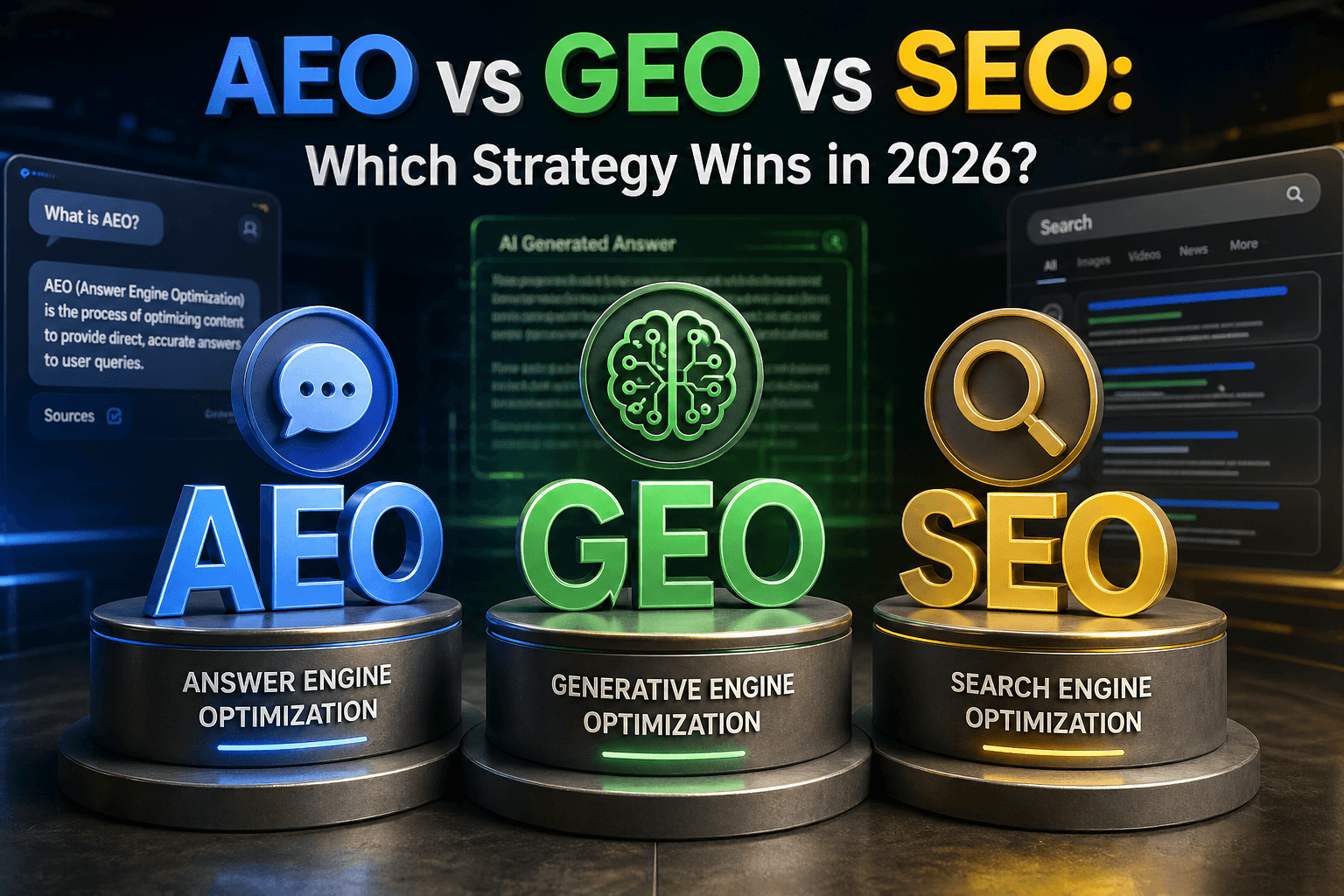
AEO vs GEO vs SEO: Which Strategy Wins in 2026?

Kartik Shah
Digital Marketing Specialist
Introduction: The Evolution of Search in 2026
If you step back and look at how we look for information today in 2026, the shift is staggering. The days of typing broken keywords into a search bar and scrolling through ten blue links feel like ancient history. Today, search behavior is fundamentally conversational. Users don't just search; they converse, ask complex questions, and expect immediate, synthesized answers.
This transformation is driven by the rapid maturation of AI-powered search engines. Platforms like Google’s AI Overviews, Gemini, Perplexity AI, and ChatGPT-style search experiences have trained users to expect direct answers rather than a list of websites to hunt through.
For marketers, business owners, startups, and SaaS companies, this means a harsh reality: traditional SEO alone is no longer enough. To capture visibility, traffic, and revenue in this AI-first ecosystem, your digital marketing strategy must evolve. Welcome to the era of Answer Engine Optimization (AEO) and Generative Engine Optimization (GEO).
What is AEO (Answer Engine Optimization)?
Answer Engine Optimization (AEO) is the process of optimizing your content to be chosen as the definitive, direct answer by AI assistants, voice search devices, and search engine answer boxes.
Instead of presenting users with a list of URLs, answer engines (like Siri, Alexa, Google Assistant, or standard search engine featured snippets) extract the single best piece of information to answer a user's query instantly.
How Answer Engines Work:
Answer engines bypass the traditional search results page. They rely heavily on structured data, content formatting, and concise writing to quickly identify facts. If a user asks a smart speaker, "What is the best CRM for small startups?" the engine scans its index for the most authoritative, clearly structured list it can find and reads it aloud.
Why Structured Content Matters:
To succeed in AEO, your content must be easily digestible by machines. This means utilizing Q&A formats, bulleted lists, and clear headings.
AEO Optimization Example: A SaaS company writes a blog post. Instead of burying the definition of their software in a massive paragraph, they include a bolded header: "What is CRM Software?" followed immediately by a concise, two-sentence definition, and then a bulleted list of core features.
What is GEO (Generative Engine Optimization)?
While AEO is about providing the single best answer for a direct question, Generative Engine Optimization (GEO) is the practice of optimizing content so that it is sourced, synthesized, and cited by generative AI search engines.
How Generative Engines Work:
Engines like Perplexity AI or Google’s advanced AI Overviews don't just pull a single snippet. They act as automated researchers. When a user enters a complex prompt, the AI reads multiple top-ranking sources, synthesizes the information into a comprehensive, original summary, and cites the sources used.
GEO vs. Traditional SEO and AEO:
Traditional SEO optimizes for clicks. AEO optimizes for direct, single-source extraction. GEO optimization is about being recognized as a credible, authoritative "ingredient" in a complex AI-generated response.
GEO Optimization Example: A marketing agency publishes a comprehensive, data-backed report on consumer spending habits. Because the report features unique statistics and expert quotes, generative AI engines pull those specific data points to build their comprehensive answers, providing a citation link back to the agency's original report.
AEO vs GEO vs Traditional SEO
To understand how these concepts overlap and differ, let’s look at a direct comparison:
Feature | Traditional SEO | AEO (Answer Engine Optimization) | GEO (Generative Engine Optimization) |
Search Intent | Informational, Navigational, Transactional | Quick, factual answers (Who, What, When) | Complex, multi-layered queries and comparisons |
Ranking Methods | Backlinks, keywords, page speed | Structured data, concise formatting, featured snippets | E-E-A-T, entity recognition, brand mentions, unique data |
Content Strategy | Long-form articles, keyword targeting | FAQs, glossary terms, Q&A formats, lists | Thought leadership, primary research, expert quotes |
User Experience | Clicks through to the website to read | Reads answer directly on the SERP or via Voice | Reads synthesized AI summary, clicks citations for depth |
AI Visibility | Low (if not optimized for AI) | High for single-intent queries | High for conversational, exploratory queries |
Conversion Impact | Relies on on-page funnels | Brand awareness, zero-click trust building | High-intent traffic from citation clicks |
How AI Search is Changing Digital Marketing in 2026
The rise of AEO in 2026 and the widespread adoption of generative AI are forcing a massive pivot in digital strategy. Here is how the landscape has shifted:
Conversational Queries are the Norm: Users no longer type "best shoes running." They ask, "What are the best running shoes for someone with flat feet running a marathon in the rain?" Your content must answer highly specific, natural-language prompts.
The Rise of Zero-Click Searches: With AI providing immediate answers directly on the search page, traditional website clicks for informational queries are dropping. Brands must learn to extract value from "zero-click" interactions by building trust and brand recall.
Authority and Trust Signals Overpower Everything: Because AI engines hallucinate, search companies have heavily weighted their algorithms toward verifiable, authoritative sources. Without massive trust signals, your content will not be cited.
Content Quality Beats Keyword Stuffing: Algorithms now understand context perfectly. Dropping keywords into a post is useless. AI engines look for nuance, original insights, and depth.
Video, Schema, and Entity SEO: The modern web is connected. AI engines prefer entities (recognized people, places, and concepts) connected by Schema markup. Video transcripts are also heavily mined for generative answers.
Best AEO Strategies for 2026
To conquer the answer box and voice search devices, implement these actionable AI SEO strategies:
Write Concise, Answer-Focused Content: Use the "inverted pyramid" style. State the direct answer clearly in the first two sentences of a section, then expand on the details below it.
Optimize Your FAQs: Build dedicated FAQ sections on your product and service pages. Phrase the questions exactly how a customer would ask them in a conversational tone.
Leverage Schema Markup: Implement advanced structured data (FAQPage, Article, LocalBusiness, Product schema) to feed search engines the exact context of your data in a language they understand natively.
Target Conversational Long-Tail Queries: Stop targeting broad terms. Focus on "How," "Why," and "What is" queries that trigger direct answers.
Build High-Authority Content Clusters: Group your content. Create a pillar page covering a broad topic, and link it to dozens of tightly related, highly specific sub-topics. This builds the topical authority that answer engines crave.
Best GEO Strategies for 2026
To ensure your brand is synthesized and cited in conversational AI tools, focus on these Generative Engine Optimization tactics:
Prioritize E-E-A-T (Experience, Expertise, Authoritativeness, Trustworthiness): Generative engines actively look for content written by vetted experts. Include author bios, cite your sources, and showcase first-hand experience in your writing.
Publish Research-Driven Content: AI engines are data-hungry. If you publish original surveys, proprietary data, or unique case studies, generative AI has no choice but to cite you when answering user questions about industry statistics.
Optimize for Entities, Not Just Words: Ensure Google recognizes your brand and key personnel as "entities" in the Knowledge Graph. This involves managing your digital PR, Wikipedia presence (if applicable), and consistent NAP (Name, Address, Phone) data.
Maximize Mentions Across the Web: Generative engines synthesize from multiple sites. If your brand is mentioned on Reddit, Quora, industry forums, and high-tier publications, the AI registers your brand as highly relevant to the topic.
Format for AI Citations: Use pull quotes, highlight key takeaways, and create custom graphics. AI models are increasingly multimodal and will pull clear, distinct elements from your site to enrich their answers.
Common Mistakes Businesses Should Avoid
As we navigate these digital marketing trends 2026, avoiding outdated tactics is just as important as adopting new ones.
Publishing Thin, AI-Generated Content: Using AI to write massive volumes of generic, unedited content is a death sentence. AI search engines easily detect and ignore cheap AI content. You must inject human insight.
Overusing Keywords: Keyword density is a relic of the past. Focus on semantic richness and covering a topic completely.
Ignoring Structured Data: If you don't use schema markup, you are forcing the AI to guess the context of your page. Don't make the AI work hard.
Relying Only on Traditional SEO: If your entire strategy relies on getting users to click a blue link for top-of-funnel informational queries, you will see a massive drop in traffic.
The Future of Digital Marketing Beyond SEO
Looking ahead, the future of SEO is less about "Search Engine Optimization" and more about optimizing for an entire AI-first ecosystem.
We are moving rapidly toward predictive search, where AI assistants anticipate what users need based on their location, calendar, and historical behavior before they even type a query. Furthermore, multimodal search—where a user points their camera at an object and asks a voice question simultaneously—is becoming a daily habit.
The most successful brands will be those that embrace a Human + AI collaborative content strategy. They will use AI to analyze data and structure pages, but rely on passionate, expert humans to inject the empathy, experience, and creativity that machines cannot replicate.
Conclusion
The rise of AI-powered search engines has irreversibly changed the digital landscape. To stay competitive in 2026, businesses must evolve beyond traditional click-based SEO. By embracing Answer Engine Optimization (AEO), you can dominate direct answers and voice search. By mastering Generative Engine Optimization (GEO), you can ensure your brand is cited and celebrated in complex AI conversations.
Adaptability is the greatest asset in digital marketing. The brands that optimize for how users actually search today—conversationally, instantly, and intelligently—will be the ones that thrive tomorrow.
Ready to Future-Proof Your Digital Strategy?
Don't let your business get left behind in the AI revolution. If you are ready to transition your brand from traditional search to dominating AEO and GEO, our team of expert digital strategists is here to help. [Contact us today for a free AI SEO audit and let’s build your 2026 growth strategy!]
FAQs about AEO & GEO
1. Does AEO mean traditional SEO is dead?
No, traditional SEO is not dead, but it has evolved. Technical SEO, site speed, and backlinks are still foundational. However, relying solely on traditional SEO without incorporating AEO and GEO strategies will result in losing visibility to AI-generated answers.
2. How do I optimize my website for AI search engines like ChatGPT or Perplexity?
Focus on Generative Engine Optimization (GEO). Publish original data, expert interviews, and comprehensive thought leadership. Ensure your site is technically sound, highly cited across the web, and features strong E-E-A-T signals.
3. Is voice search optimization the same as AEO?
Voice search optimization is a major subset of AEO. Because smart speakers generally read one single answer aloud, optimizing for AEO (using concise formats and schema) directly improves your chances of capturing voice search queries.
4. Why is my website traffic dropping even though my rankings are the same?
This is likely due to the rise of zero-click searches. AI Overviews and answer engines are giving users the information they need directly on the search results page, meaning fewer users need to click through to your website for basic information.
5. Can I use AI to write my AEO and GEO content?
You can use AI for outlining, data analysis, and structuring, but publishing raw, unedited AI content is a major mistake. AI search engines prioritize unique human experiences, original research, and genuine expertise—things generative tools cannot create on their own.