[ News and Blog ]
The Power of Parasite SEO in 2026: Strategy, Benefits & Real Results

Kartik Shah
Digital Marketing Specialist
Table of Contents
1. Introduction: The SEO Landscape Has Shifted
2. What Is Parasite SEO?
3. Why Parasite SEO Works in 2026
4. Core Parasite SEO Strategy (Step-by-Step)
5. The Real Benefits of Parasite SEO
6. Real Results: A VNA Infotech Case Study
7. Parasite SEO vs Traditional SEO
8. Risks & Best Practices
9. The Future: AI Search, GEO & What Comes Next
10. Conclusion & CTA
"If you're still waiting 12 months to see SEO results while your competitors are showing up on page one in weeks, you're not playing the same game they are."
The search landscape in 2026 looks nothing like it did three years ago. Google's AI Overviews now answer millions of queries before a user clicks a single link. Perplexity, ChatGPT, and Gemini handle questions that used to drive traffic to entire websites. Core Web Vitals, EEAT signals, and SpamBrain algorithm updates are evolving faster than most in-house teams can track.
In this environment, one strategy has been quietly gaining serious traction among experienced SEO experts in Ahmedabad and globally: parasite SEO. And in 2026, it's no longer a grey-hat trick whispered in backroom forums. When done with quality and intent, it's a legitimate, powerful approach to organic visibility — and one of the fastest ways to generate real results for businesses of all sizes.
This article breaks down exactly what parasite SEO is, the mechanics of why it works in today's AI-driven search environment, how to build a real strategy around it, and how VNA Infotech, one of Ahmedabad's leading digital marketing agencies, uses it to deliver measurable outcomes for clients across industries.
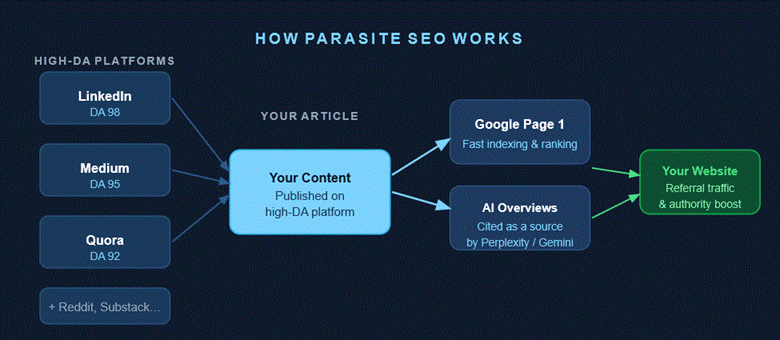
Fig. 1 — How Parasite SEO channels the authority of high-DA platforms into Google rankings, AI citations, and referral traffic for your own site.
2. What Is Parasite SEO?
The name sounds aggressive — almost predatory. But the concept behind it is surprisingly clean and logical.
Parasite SEO is the practice of publishing optimized content on high-authority, third-party platforms — sites that Google already trusts deeply — in order to rank for competitive keywords far faster than your own domain could on its own.
Here's the core insight: Google doesn't just rank pages; it ranks pages from websites it trusts. When you publish a well-crafted article on LinkedIn (Domain Authority: 98), Medium (DA: 95), or Quora (DA: 92), that content inherits years of Google trust — established through millions of backlinks, billions of page visits, and consistent quality signals — that your own website may take years to accumulate.
A practical example: suppose you run a digital marketing agency in Ahmedabad and want to appear in search results for "best SEO services in Ahmedabad." Ranking your own homepage for that term against established local competitors might take 9–12 months of sustained effort. A well-optimized LinkedIn article targeting the same phrase could crack page one in 3–6 weeks. Both approaches have their place — and together, they're unstoppable.
What parasite SEO is not: it's not spam. It's not link schemes or low-quality AI-generated filler posted in bulk across hundreds of forums. The 2026 version of this strategy is built on genuine expertise, quality content, and smart platform selection — which is why it's increasingly embraced by serious agencies as a core tactical tool.
3. Why Parasite SEO Works in 2026
Several converging forces in 2026's search environment have made this strategy more effective than at any previous point.
Google's trust hierarchy is steeper than ever. After years of algorithm updates targeting thin content, link spam, and AI-generated fluff, Google has doubled down on rewarding established, authoritative sources. Platforms like LinkedIn, Medium, Substack, and industry-specific publication networks have invested heavily in content quality and spam prevention — earning them an exceptionally high baseline of Google trust. Content you publish on these platforms taps into that trust from day one.
AI Overviews favor authoritative sources. This is arguably the biggest shift in 2026. Google's AI-generated answer panels — now appearing for the majority of informational queries — actively pull content from the most authoritative, well-structured sources available. When your parasite SEO article on Medium or LinkedIn is structured as a genuine, expert resource, it's precisely the type of content these AI systems are designed to surface. You're not just ranking in traditional results; you're being cited in the AI layer of search.
Faster indexing closes the time gap dramatically. Google crawls high-authority platforms continuously — sometimes multiple times per day. A new article on your own domain might sit unindexed for days or weeks. The same article on LinkedIn could appear in search results within hours of publication. For businesses that need visible results quickly, this speed difference is significant.
EEAT signals are inherited, not just earned. Google's EEAT framework rewards Experience, Expertise, Authority, and Trust. When you publish on a platform with a strong editorial reputation, your content inherits a layer of credibility that signals trustworthiness to Google's quality raters — even before readers engage with it.
4. Core Parasite SEO Strategy: Step-by-Step
Effective parasite SEO isn't random publishing. Every element — from platform selection to content structure to link placement — needs to be deliberate. Here's how experienced practitioners approach it.
Step 01
Platform Selection
Match platform authority with your audience. LinkedIn for B2B; Medium for thought leadership; Quora for FAQ-intent queries; Reddit for community-driven topics. Industry directories can outperform general platforms for niche searches.
Step 02
Keyword Targeting
Focus on terms where high-DA platforms already appear in top results — this confirms Google welcomes this type of source for that query. Long-tail keywords with commercial intent are the sweet spot.
Step 03
Content Optimization
Target keyword in the title, first paragraph, and subheadings. Use FAQ sections and direct answers to capture featured snippets and AI Overview citations. Content must be genuinely expert-level.
Step 04
Internal Linking
Include 1–2 natural, contextually relevant links back to your own service pages. This transfers some platform authority to your domain and creates a measurable referral traffic channel.
Step 05
Track & Scale
Monitor each article's rankings separately. Identify top-performing platforms, content types, and keyword clusters. Systematically expand to build multi-platform presence across your core topics.
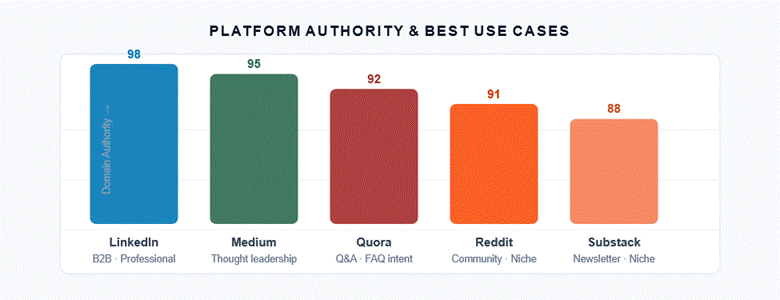
Fig. 2 — Domain Authority comparison of key parasite SEO platforms and their ideal content use cases in 2026.
5. The Real Benefits of Parasite SEO
The appeal of parasite SEO goes well beyond speed — though that's where most conversations start. For startups and businesses entering competitive markets, the most painful reality of traditional SEO is that real results often take 9–18 months to materialize. During that time, competitors with established domain authority continue capturing every lead that a newer site could have won. Parasite SEO closes that gap dramatically, allowing even a brand-new business to appear on page one for relevant searches within weeks of launching a strategy.
The cost efficiency is equally meaningful. Traditional SEO campaigns targeting competitive keywords require sustained investment in technical work, content production, and link acquisition — often for many months before the ROI becomes clear. A well-executed parasite SEO campaign can produce top-ranking content for target keywords with a fraction of that commitment, making it genuinely accessible for local businesses and lean startups managing tight marketing budgets.
For businesses targeting local SEO in Ahmedabad or Surat, parasite SEO is one of the most underused tools available. Publishing expert local content on high-DA platforms — about market trends, industry insights, or local guides — captures searches that would otherwise go to much larger, better-established sites. The local signal from well-targeted content compounds with platform authority to produce impressive local visibility.
Perhaps most valuably in 2026's multi-surface search environment, parasite SEO creates brand omnipresence. When your content appears across LinkedIn, Medium, Quora, and industry platforms for related keyword clusters, potential customers encounter your brand repeatedly, across different contexts. This repetition builds the kind of organic trust and recognition that no single page-one ranking can create alone.
6. Real Results: A VNA Infotech Case Study
VNA Infotech, Ahmedabad's most trusted full-service SEO and digital marketing agency, has embedded parasite SEO as a core component of client campaigns with consistent, documentable results. Here's how it played out for one of their professional services clients.
VNA Infotech · Client Case Study · 2026
Professional Services Firm Generates 40% More Inbound Leads in 60 Days
The Challenge
A mid-sized professional services firm in Ahmedabad had a technically sound website but minimal organic visibility. Their domain was relatively new, and traditional SEO was projected to take 10–12 months to deliver meaningful traction — a timeline incompatible with their aggressive growth targets. Their core service keywords were dominated by established national competitors with years of SEO investment behind them.
The Strategy
VNA Infotech's team identified 12 high-intent, mid-competition keywords where LinkedIn articles and Medium posts were already appearing in Google's top results. They developed an 8-piece content plan distributed across LinkedIn Pulse, Medium, and two industry-specific directories — each piece crafted with genuine expertise, FAQ-structured for AI Overview eligibility, and seeded with strategic links back to the client's service pages. The campaign ran in parallel with an ongoing traditional SEO build on the client's own domain.
The Results
5 wks
Time to first page-one ranking from publication
+68%
Organic referral traffic to client website within 8 weeks
+40%
Increase in qualified inbound leads within 60 days
Key Insight
Three of the eight parasite articles ranked on page one within five weeks. Two appeared directly in Google AI Overview panels for their target queries. The referral traffic flowing to the client's own domain — combined with the authority signals from the parasite content — also accelerated their traditional SEO campaign by an estimated 3–4 months. The 60-day lead increase would have been impossible through organic SEO alone on a new domain.
7. Parasite SEO vs Traditional SEO
The question most business owners ask is: "Which approach should I use?" The honest answer — supported by results like the case study above — is that they're not competing strategies. They're complementary tools that serve different timelines and objectives.
Factor | Parasite SEO | Traditional SEO |
Time to first results | 2–6 weeks | 6–18 months |
Domain authority required | None (leverages platform DA) | Must be built over time |
Content ownership | Third-party platform | Fully owned asset |
Long-term compounding | Moderate — platform-dependent | Strong — your domain grows |
Cost to start | Low | Medium–High |
AI Overview eligibility | High (inherits platform trust) | Requires strong EEAT build |
Risk level | Low (if quality-first) | Low (consistent, ethical) |
Best for | Speed, new sites, competitive terms | Long-term authority, scalability |
The smartest SEO strategy in 2026 runs both tracks simultaneously: parasite SEO generates early visibility and leads, while traditional SEO builds the owned, compounding asset that sustains growth for years. VNA Infotech consistently recommends and executes this integrated approach for clients across all industries.
8. Risks & Best Practices: Doing It Right in 2026
Parasite SEO done carelessly can produce the opposite of its intended outcome. Here's what to watch for and how to stay on the right side of both Google's guidelines and platform policies.
Google SpamBrain Warning: In 2026, Google's AI-powered spam detection can identify thin, manipulative, or purely self-promotional content on third-party platforms — and devalue or remove it from results. An article that exists purely to place a link back to your site, with no genuine informational value, is increasingly likely to be filtered out. Quality is not optional; it's the only approach that survives algorithm scrutiny.
Every parasite SEO piece must stand on its own as a genuinely useful resource. Ask: would this article help a reader even if every link to my website were removed? If the honest answer is no, the content needs to be substantially improved before publication.
Diversify across platforms rather than concentrating on a single channel. If LinkedIn adjusts its publishing algorithm or Medium updates its content policies — both of which have happened — a diversified portfolio of parasite content is resilient in ways that a single-platform strategy is not.
Keep self-linking proportional. One or two contextually natural links to your own website per article is entirely appropriate. More than that is a signal of manipulation and can trigger platform-level content removal or Google devaluation. Let the content earn the click, not the link count.
Monitor performance actively. Rankings on third-party platforms can fluctuate as competitors publish competing content or platform algorithms evolve. Parasite SEO is not a "set and forget" strategy — it rewards teams that track, adapt, and consistently refresh their best-performing content.
9. The Future: AI Search, GEO & What's Next
The most exciting development for parasite SEO in 2026 is how naturally it aligns with the AI-driven search future — and this alignment is only deepening.
Google's AI Overviews, Perplexity's answer synthesis, and ChatGPT's browsing capabilities all preferentially surface content from platforms with established authority when generating responses. A well-structured, expert-level article published on LinkedIn or Medium is not just ranking in traditional blue-link results — it's actively being cited by AI systems as a trusted source for topic queries. This is the core idea behind Generative Engine Optimization (GEO): building the kind of credible, well-structured, genuinely expert content that generative AI systems recognize and amplify.
Parasite SEO on high-authority platforms is, in practice, one of the most natural expressions of GEO principles. Which is precisely why its relevance is growing rather than diminishing as AI reshapes the search landscape.
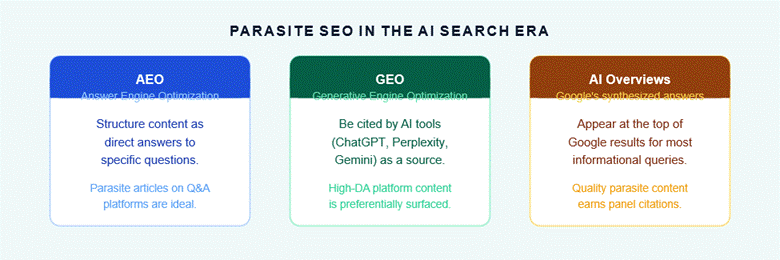
Fig. 3 — Parasite SEO sits at the intersection of AEO, GEO, and Google AI Overviews — the three emerging pillars of AI-driven search visibility in 2026.
For businesses serious about long-term digital visibility, combining parasite SEO with Answer Engine Optimization (structuring content with direct answers, FAQ schema, and clean heading hierarchies) creates a presence that spans both traditional and AI-driven search surfaces. This is precisely the combination that forward-thinking SEO services in Ahmedabad — and VNA Infotech in particular — are building into every client campaign.
10. Conclusion: The Right Strategy for 2026 and Beyond
Parasite SEO in 2026 is not a shortcut. It's not a loophole or a trick. At its best, it's an intelligent allocation of effort — leveraging the trust and authority that established platforms have spent years building, to accelerate your own path to search visibility and business growth.
The businesses generating the best results are those treating it as one pillar of a broader, integrated strategy: quality content that genuinely serves readers, smart platform selection, strategic internal linking, and a parallel investment in long-term organic authority on their own domains.
That integrated approach — combining parasite SEO with technical excellence, content strategy, and AI-era optimization — is exactly what VNA Infotech delivers for every client. As Ahmedabad's most trusted SEO and digital marketing agency, VNA Infotech brings the expertise, tools, and track record to build campaigns that perform in today's complex, AI-driven search environment.