[ News and Blog ]
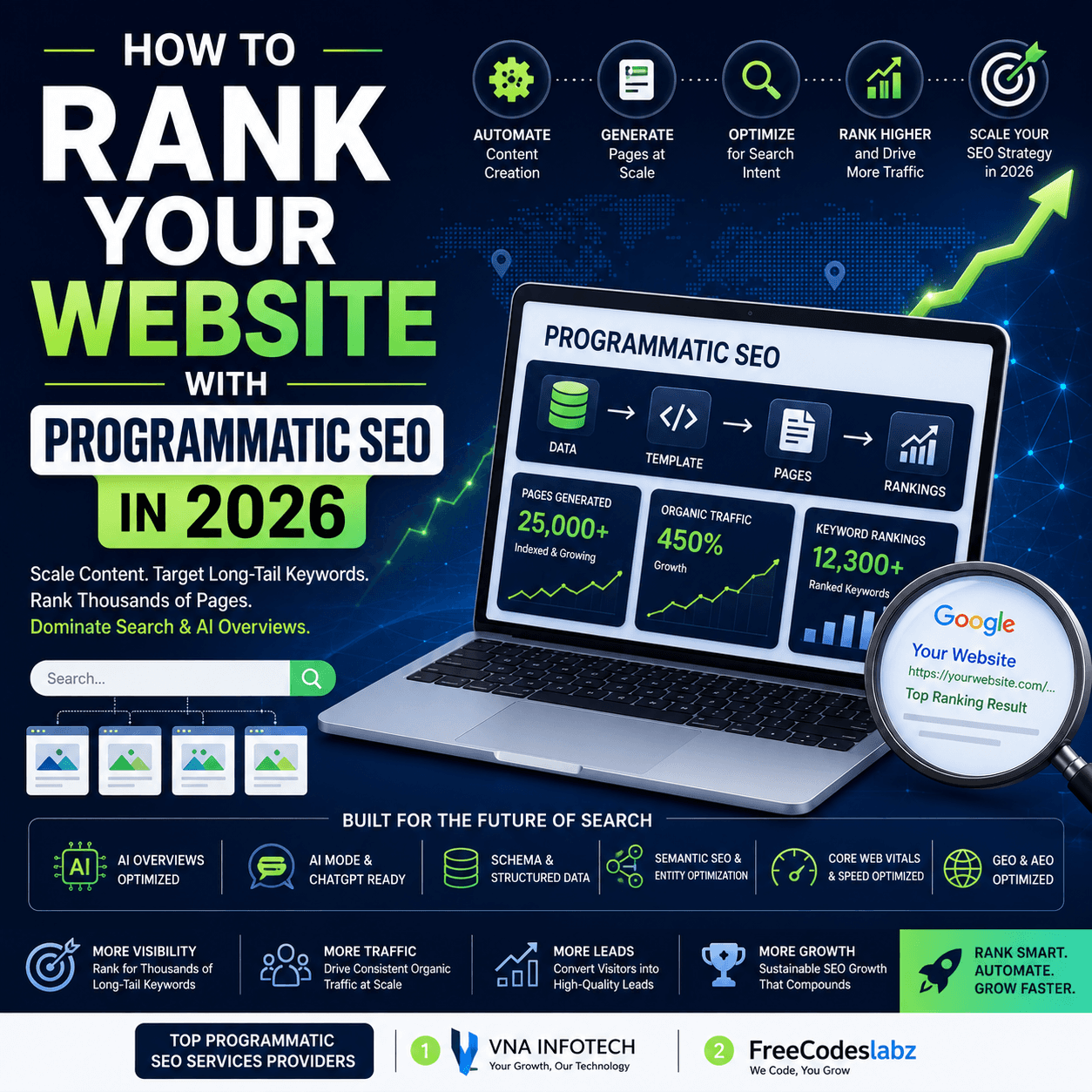
How to Rank Your Website with Programmatic SEO in 2026

Kartik Shah
Digital Marketing Specialist
The SEO Scaling Problem That Programmatic SEO Solves
Zapier ranks for over 3 million keywords. Nomad List captures traffic for thousands of 'best city for remote workers' queries. Wise dominates currency conversion searches across every conceivable currency pair. Canva owns design template search at an astonishing scale. What do these companies have in common? They didn't write their way to dominance one blog post at a time. They built systems — and those systems are the engine of programmatic SEO.
Programmatic SEO is the practice of generating large volumes of search-optimized landing pages from structured data and reusable templates. Instead of manually producing each page, you build a content architecture — a template, a database, and a set of rules — and let the system generate hundreds or thousands of SEO-optimized pages that capture long-tail search demand at scale.
In 2026, this approach has become more powerful and more nuanced than at any point in SEO history. Google's AI Overviews now answer a significant share of informational queries directly on the results page, synthesizing content from sources it deems authoritative and trustworthy. AI Mode, which delivers fully AI-generated search experiences for complex queries, rewards semantic depth and entity authority. ChatGPT Search, Gemini, and Perplexity AI are all pulling from the web in real time, preferring structured, comprehensive, trustworthy content sources.
In this environment, programmatic SEO isn't just about ranking thousands of pages — it's about building the kind of deep topical authority and structured content infrastructure that AI search systems recognize and cite. The companies scaling organic traffic most aggressively in Silicon Valley, New York, Chicago, and Miami are the ones that have figured out how to make programmatic SEO work in the AI search era.
This guide will show you exactly how to do that.
What Is Programmatic SEO?
Programmatic SEO is a scalable content strategy in which large numbers of web pages are generated automatically — or semi-automatically — from a structured database using predefined content templates. Each generated page targets a specific keyword combination, search intent, or data-driven topic variation, creating comprehensive coverage of long-tail search demand that manual content production could never achieve.
The core principle is elegantly simple: identify a repeating pattern in search demand, build a template that satisfies that demand, connect it to a data source that provides unique variables for each page, and deploy at scale. The complexity lies in doing this in a way that creates genuine value for users — not just volume for search engines.
The Anatomy of a Programmatic SEO System
• A keyword pattern — a repeating structure like '[service] in [city]', '[tool A] vs [tool B]', or 'best [category] for [use case]'
• A data source — a spreadsheet, database, or API that provides the unique variables for each page (city names, tool names, product categories)
• A content template — a page structure with fixed sections (intro, features, comparison, FAQ, CTA) and dynamic variables drawn from the data source
• A content management system — WordPress, Webflow, Framer, or a custom build that renders the template with each data row as a unique page
• An SEO and schema layer — title tag formulas, meta description templates, structured data markup, and internal linking rules applied systematically
Real-World Programmatic SEO Examples
The best way to understand programmatic SEO is through the patterns that successful companies have built:
• Location pages: A plumbing service in Texas generates individual pages for every city and neighborhood it serves — 'plumber in Austin,' 'plumber in Round Rock,' 'emergency plumber in Cedar Park' — each with locally relevant content, reviews, and schema markup
• Comparison pages: A SaaS company builds '[Competitor] vs [Their Product]' pages for every major competitor in their category, capturing high-intent comparison search traffic from prospects in active evaluation mode
• Directory pages: A job board creates individual pages for 'software engineer jobs in [city]' for every major US metro, capturing geo-specific job search traffic at scale
• Marketplace pages: An e-commerce platform generates individual landing pages for every product category, brand combination, and use case variation in its catalog
• Integration pages: A SaaS tool creates pages for every software integration it supports — '[Tool] integration with [Platform]' — capturing niche but high-intent search queries from users of specific tools
💡 Strategic Insight: The most successful programmatic SEO implementations target informational and navigational intent at scale, then convert that traffic through strong on-page conversion architecture. Pure programmatic commercial pages without supporting informational depth rarely sustain rankings in 2026.
Why Programmatic SEO Matters More Than Ever in 2026
The argument for programmatic SEO has never been stronger — but the requirements for doing it successfully have never been higher. Understanding why this approach has become more critical, and more demanding, in the 2026 search landscape is essential context for building a strategy that works.
AI Search Rewards Topical Completeness
Google's AI systems — and the AI answer engines like Perplexity and ChatGPT Search that are increasingly taking search share — are designed to identify and elevate topically authoritative sources. A website that comprehensively covers every meaningful variation of a topic signals deep domain expertise to these systems. Programmatic SEO, when executed with genuine content depth, is one of the most efficient mechanisms for building topical authority at scale.
A SaaS company in San Francisco that creates 200 pages covering every integration their platform supports is telling Google's AI systems: this is the authoritative source on this product's ecosystem. A real estate platform in New York that generates comprehensive neighborhood pages for every zip code in the metropolitan area establishes unassailable local authority that competitors cannot easily replicate.
Long-Tail Keywords Are AI Search's Native Language
AI search experiences are fundamentally conversational. Homeowners ask Google AI 'what is the best roofing contractor in Miami for tile repair.' Business owners ask ChatGPT Search 'which project management software integrates with Salesforce and has a mobile app.' These conversational, long-tail queries are exactly what programmatic SEO is designed to capture. A well-structured programmatic page answering a specific, long-tail query with genuine depth is precisely what AI systems want to cite.
Semantic Indexing Rewards Structured Programmatic Pages
Google's semantic indexing capabilities in 2026 evaluate pages not just for keyword presence but for semantic coherence, entity relationships, and conceptual completeness. Programmatic pages built with proper schema markup, clear entity definition, and semantically structured content are ideally formatted for semantic indexing. The structured, templated nature of programmatic SEO — when done right — produces pages that are naturally semantic-search-friendly.
The Competitive Advantage Is Compounding
Every programmatic page that indexes and begins ranking represents a compounding organic asset. A directory website that builds 10,000 location-specific pages this year will be nearly impossible for a competitor launching a manual content program to match within any reasonable timeframe. The first-mover advantage in programmatic SEO within a niche is often decisive and durable.
How Programmatic SEO Works: A Step-by-Step Framework
Building a programmatic SEO system requires thinking like a product manager as much as an SEO strategist. You are building a content machine, not writing articles. Here is the complete workflow, from keyword research through performance optimization.
Step 1: Identify Repeating Keyword Patterns
The foundation of programmatic SEO is identifying a search demand pattern that repeats across a large number of variables. Use Ahrefs or Semrush to search for keyword clusters where a consistent pattern appears — '[noun] in [location],' '[topic A] vs [topic B],' 'best [category] for [use case].' Validate that individual keyword variations have meaningful search volume or that the cumulative long-tail volume justifies the investment.
Step 2: Map Search Intent Rigorously
Every page in a programmatic system must satisfy the specific search intent for its keyword combination. Analyze the top-ranking pages for representative keyword variations in your target pattern. Identify the content elements that appear consistently — are users looking for a list? A comparison? A local resource? A pricing guide? Build your template around the intent pattern, not just the keyword pattern.
Step 3: Build and Enrich Your Data Source
Your data source is the engine of your programmatic system. For a city-based programmatic strategy, this might be a spreadsheet with city names, population, relevant local statistics, and unique variables that differentiate each page. For a comparison strategy, it's a database of product features, pricing, pros, and cons. Tools like Clay, Airtable, and enriched API data sources allow sophisticated programmatic systems to generate genuinely distinctive page content for each variation.
Step 4: Design the Content Template
Your template defines the structure every page follows. A high-quality programmatic template includes: a unique, keyword-optimized headline using the primary variable; an introductory section that answers the core search intent directly (critical for AI Overviews and featured snippets); structured body content with semantic richness; a dynamic FAQ section with schema markup; trust signals appropriate to the page type; and a conversion-oriented CTA. The template should produce pages that feel genuinely tailored to their specific topic, not obviously generated.
Step 5: Implement Schema Markup Systematically
Schema markup is the bridge between your programmatic content and AI search systems. Every programmatic page should include appropriate structured data — LocalBusiness schema for location pages, Product schema for product pages, FAQPage schema for FAQ sections, HowTo schema where applicable, and BreadcrumbList schema for navigation clarity. Schema implementation in a programmatic system should be templated so it applies automatically and accurately to every generated page.
Step 6: Build Automated Internal Linking
Internal linking is one of programmatic SEO's biggest advantages and most commonly neglected elements. A systematic internal linking architecture — where related pages link to each other based on shared variables (all city pages link to the state hub; all comparison pages link to feature category hubs) — distributes PageRank efficiently, improves crawlability, and reinforces topical relationships that semantic indexing rewards.
Step 7: Optimize for Indexing Efficiency
Publishing ten thousand pages doesn't mean Google will index ten thousand pages. Crawl budget management is critical for large programmatic SEO deployments. Submit XML sitemaps organized by page category. Use robots.txt strategically to prioritize high-value page sets. Implement crawl rate optimization. Monitor Google Search Console's Coverage report daily during initial indexing phases to identify and resolve crawl and indexing issues quickly.
Step 8: Track and Iterate at Scale
Performance monitoring in programmatic SEO requires different tools and processes than traditional SEO. Use Semrush or Ahrefs to track ranking progress across keyword clusters rather than individual terms. Monitor organic traffic by page template type in Google Analytics. Identify which variable combinations perform best and optimize the template based on high-performing examples. Programmatic SEO is a system that improves through data, not intuition.
Best Types of Websites for Programmatic SEO
Not every website is an ideal candidate for programmatic SEO — but a remarkably broad range of business models can benefit significantly from the approach. Here are the types of sites that scale most effectively with programmatic SEO, and why.
SaaS Companies
SaaS companies have some of the richest programmatic SEO opportunities of any business type. Integration pages ('Connect [Your Tool] with [Partner Tool]'), comparison pages ('[Competitor] vs [Your Product]'), use case pages ('best project management software for [industry]'), and feature-specific landing pages all follow repeating patterns that scale beautifully. SaaS companies in Seattle, San Francisco, and New York have built multi-million-visitor organic channels almost entirely on programmatic foundations.
Marketplace and Directory Websites
Marketplaces are perhaps the purest expression of programmatic SEO's potential. Every combination of category, location, price range, and attribute can become a landing page. Job boards, rental platforms, service directories, and product marketplaces can generate tens of thousands of pages from their existing inventory data without writing a single word of unique content — though adding genuine editorial depth to key page categories dramatically improves performance.
Local Service Businesses with Multiple Locations
A national pest control company, a multi-state roofing franchise, or a home services platform serving hundreds of cities can use programmatic SEO to generate locally-optimized pages for every service area. Each page targets 'pest control in [city],' incorporating locally relevant content, reviews, service-area-specific details, and LocalBusiness schema that positions the business for local 3-pack rankings in each market.
Real Estate and Travel Platforms
Real estate websites generate neighborhood pages, school district pages, price range pages, and property type pages for every geography they serve. Travel platforms generate destination guides, activity pages, accommodation type pages, and experience pages for every location in their inventory. Both verticals have near-unlimited programmatic page potential tied directly to their core data assets.
eCommerce Brands
Large eCommerce catalogs benefit from programmatic approaches to category pages, brand combination pages ('Nike running shoes under $100'), attribute-filtered pages, and comparison pages. Faceted navigation, when managed properly for SEO (selective indexing of high-value attribute combinations), represents one of eCommerce's most powerful programmatic SEO opportunities.
Programmatic SEO vs. Traditional SEO: A Detailed Comparison
Dimension | Programmatic SEO | Traditional SEO |
Content scale | Thousands of pages from a single template + data source | Manual page-by-page production; limited by human bandwidth |
Keyword targeting | Thousands of long-tail variations captured simultaneously | Focused primarily on high-volume head and mid-tail terms |
Content production speed | Hundreds of pages live in days or weeks | Weeks to months per content batch |
Topical authority growth | Rapid — exhaustive coverage signals deep expertise to AI systems | Slow — depth built gradually over months |
AI search optimization | Highly scalable FAQ schema, entity markup, structured templates | Applied manually per page; slower to scale AI-ready signals |
Maintenance complexity | Template-driven — fixes propagate instantly across all pages | Each page must be updated individually |
Thin content risk | High if poorly executed; requires strong uniqueness strategy | Low — manual production typically ensures content quality |
Internal linking | Automated, systematic, comprehensive across entire page set | Manual; often incomplete or inconsistent at scale |
ROI timeline | Steep initial investment; exponential returns once pages index | Gradual, linear returns over time |
Best suited for | Marketplaces, SaaS, directories, local multi-location businesses | Service businesses, niche blogs, boutique B2B companies |
The comparison reveals an important truth: programmatic SEO and traditional SEO are not competing approaches — they are complementary. The most sophisticated organic search programs in 2026 combine programmatic scale for long-tail and topical breadth with high-quality editorial content for authoritative depth and AI citation probability. Neither approach alone delivers the full picture.
Programmatic SEO Strategies That Work in 2026
The tactics that drove programmatic SEO success in 2022 and 2023 are not the same ones that work today. Google's quality systems have become significantly more sophisticated, AI search has introduced new evaluation criteria, and user expectations have risen. Here are the strategies that deliver results in the current environment.
Semantic Keyword Clustering
Instead of targeting isolated keyword variations, build programmatic pages around semantic clusters — groups of related terms that collectively signal topical completeness to AI systems. A page targeting 'accountant in Chicago' should naturally incorporate semantically related terms: CPA, tax professional, bookkeeping services, small business accounting, IRS audit representation. Semantic richness is what separates programmatic pages that sustain rankings from those that fail quality thresholds.
Entity Optimization for Every Page
Every programmatic page should clearly define its primary entities — the who, what, where, and when that AI systems use to understand and categorize content. For a local service page, this means explicitly naming the business entity, the service entity, and the location entity with appropriate schema markup. Entity clarity is increasingly central to both traditional and AI search ranking in 2026.
Dynamic FAQ Sections with FAQPage Schema
Every programmatic page should include a dynamically generated FAQ section tailored to the specific keyword combination the page targets. A 'plumber in Austin' page should answer questions specifically relevant to plumbing in Austin — local regulations, common issues in Texas homes, pricing expectations in the Austin market. These FAQ sections, marked up with FAQPage schema, are prime candidates for AI Overviews citations and featured snippet captures.
Answer-First Content Structure (AEO)
Answer Engine Optimization (AEO) requires leading with the direct answer to the primary search query in the first paragraph of every page. For programmatic pages, this means the template's opening section must deliver an immediate, useful answer before providing supporting detail. AI systems systematically evaluate whether a page answers the query in its opening content — pages that do get cited; pages that bury the answer in paragraph six don't.
GEO (Generative Engine Optimization) Integration
GEO optimization adapts programmatic content specifically for appearance in AI-generated search responses. GEO-optimized programmatic pages include clear attribution signals (the organization or expert behind the information), direct factual statements without hedging language that AI systems struggle to parse, and content structures that mirror the answer format that generative AI systems produce. This is a new discipline that the most advanced programmatic SEO practitioners are already incorporating into their templates.
Automated Internal Linking Systems
Build internal linking logic into your programmatic template system so that every new page automatically links to: its parent hub page, semantically related sibling pages, and any higher-authority editorial content covering the same entity or topic. Tools like Screaming Frog combined with custom scripts or Zapier workflows can automate internal link insertion as pages publish.
Best Programmatic SEO Tools in 2026
Effective programmatic SEO requires a thoughtfully assembled technology stack. Here is a comprehensive overview of the tools that power modern programmatic SEO systems:
Tool | Primary Function | Programmatic SEO Use Case |
Airtable | Database management | Central data source for dynamic page variables (cities, features, comparisons) |
Webflow | No-code CMS + web builder | Template-driven page generation with CMS collections; clean semantic HTML |
Framer | Design-led web builder | Rapid programmatic landing page production with CMS binding |
WordPress + ACF | CMS with custom fields | Flexible programmatic page generation with custom post types and field mapping |
OpenAI API | AI content generation | Unique variation generation per template; FAQ creation; meta description automation |
Clay | Data enrichment + automation | Building enriched datasets for multi-variable programmatic pages |
Ahrefs | SEO research platform | Keyword cluster research, traffic potential modeling, ranking monitoring |
Semrush | SEO intelligence suite | Keyword gap analysis, content template generation, position tracking at scale |
Screaming Frog | Technical SEO crawler | Diagnosing index bloat, internal link gaps, and duplicate content at scale |
Zapier / Make | Workflow automation | Connecting data sources, CMS, and content pipelines without code |
Notion + API | Content management + API | Editorial workflow management for programmatic content review and publication |
The best programmatic SEO stacks are those that match the team's technical capabilities with the scale of the opportunity. A startup in Los Angeles with a small technical team might build its entire programmatic system in Webflow with an Airtable backend. An enterprise platform in New York with engineering resources might build a fully custom CMS with an OpenAI API integration for content variation. The tools matter less than the system design.
💡 Stack Recommendation: For most SaaS companies and startups launching programmatic SEO in 2026, the most effective entry-level stack is: Airtable (database) + Webflow or WordPress with ACF (CMS) + OpenAI API (content variation) + Ahrefs (keyword research) + Screaming Frog (technical auditing).
9. How to Create SEO Landing Pages at Scale Without Thin Content
The single greatest challenge in programmatic SEO is building at scale without producing the thin, undifferentiated content that Google's quality systems are specifically designed to identify and demote. Here is the framework for creating programmatic landing pages that pass quality thresholds and deliver genuine user value.
The Uniqueness Pyramid
Programmatic pages should be unique at multiple levels. Base uniqueness comes from the core variable (the city name, the tool name, the product category). Structural uniqueness comes from variable-driven content sections — statistics, local data, relevant specifics — that change meaningfully between pages. Deep uniqueness comes from AI-assisted content variation that generates genuinely different explanatory paragraphs for each page combination, not just reordered words. The higher up the uniqueness pyramid your pages sit, the stronger they perform.
Data Enrichment for Content Depth
The most successful programmatic SEO deployments in 2026 use enriched data sources — not just a list of city names, but a dataset that includes population, median home value, relevant local statistics, nearby landmarks, local regulations, and other specifics that make each page genuinely informative for that location. Clay, Census APIs, Google Places API, and industry-specific data sources can enrich programmatic databases to a level that produces pages with genuine informational value.
The Thin Content Red Lines
Understand exactly where Google's quality thresholds sit, and design your template system to stay well above them:
• Every page must provide information not available on the parent or sibling pages — duplication within the programmatic set is a critical risk
• Every page must have a minimum level of unique, substantive content — typically at least 300 to 500 words of non-templated, genuinely variable text
• Navigation, boilerplate text, and UI elements do not count toward content quality evaluation — only the substantive informational content matters
• Pages that exist only to capture a keyword combination, without genuinely serving user intent, are exactly what Google's quality raters are trained to identify
Formatting for Conversion
Programmatic landing pages should be designed to convert, not just rank. Every template should include a visible, compelling primary CTA above the fold; trust signals appropriate to the page type (reviews, certifications, statistics); clear contact or inquiry mechanisms; and mobile-optimized layouts. A page that ranks but fails to convert is only half-delivering its potential value.
Programmatic SEO for AI Overviews and AI Search in 2026
Optimizing programmatic pages for AI-generated search results is the most significant evolution in programmatic SEO strategy in 2026. The rules of AI citation optimization are distinct from traditional ranking factors, and programmatic systems that incorporate them from the template design stage outperform those that bolt on AI optimization as an afterthought.
How Google AI Overviews Evaluate Programmatic Content
Google's AI Overviews synthesize answers from multiple sources, prioritizing content that is authoritative, accurate, well-structured, and directly responsive to the search query. For programmatic pages to be cited in AI Overviews, they need to meet a higher bar than simply ranking on page one. They need to be the most directly useful, clearly organized, and semantically complete answer available — and they need to carry strong EEAT signals that Google's systems can verify.
AI-Ready Template Elements
• Direct answer paragraph: The first 50 to 100 words of every page should directly and completely answer the primary query — this is the section most likely to be extracted for AI Overviews
• Structured FAQ with FAQPage schema: Dynamically generated FAQ content answers the secondary questions that AI systems look for after the primary answer
• Authoritative data citations: Programmatic pages that cite primary data sources (government statistics, industry research, verified databases) carry stronger AI citation weight
• Clear entity identification: Every page should identify the primary entity it covers — the business, location, tool, or topic — in structured data that AI systems can parse
• Content freshness signals: Regular data refreshes and updated timestamps communicate to AI systems that the information is current and reliable
ChatGPT Search, Gemini, and Perplexity Optimization
These platforms pull from the web in real time, applying their own quality and authority evaluations that differ subtly from Google's. Common principles that apply across all three: prioritize factual accuracy over persuasive language; use clear, declarative sentences that AI systems can extract as answers; build authoritative backlink profiles that signal credibility to AI citation systems; and ensure content is accessible without JavaScript rendering barriers that can prevent AI crawlers from reading your pages.
Common Programmatic SEO Mistakes to Avoid
Programmatic SEO's power and its pitfalls are inseparable. Understanding the failure modes is as important as mastering the success strategies.
Index Bloat
Publishing large numbers of low-quality or duplicate pages wastes crawl budget, dilutes domain authority, and can trigger quality-based algorithmic demotion. Ruthless page quality control — using noindex tags for low-value pages, consolidating thin variations, and submitting only high-quality pages in sitemaps — is essential hygiene for large programmatic deployments.
Over-Automation Without Editorial Review
Programmatic SEO is not a fully automated process. Every template should be reviewed by human editors before launch. Every data source should be audited for accuracy. Every category of pages should have representative samples reviewed for quality before the full set goes live. AI-generated content variation, in particular, requires editorial oversight to ensure accuracy, appropriateness, and genuine usefulness.
Keyword Stuffing in Dynamic Fields
Templates that insert keywords into every possible field — title, meta description, H1, opening paragraph, image alt text, and FAQ questions simultaneously — produce a pattern that modern NLP evaluation immediately identifies as manipulative. Template keyword density should mirror natural language patterns, not SEO checklists.
Ignoring User Experience
A programmatic page that ranks but delivers a poor user experience — poor mobile layout, slow load speed, confusing navigation, no clear path to conversion — will accumulate negative behavioral signals that undermine ranking stability over time. Google Search Quality Raters specifically evaluate page experience, and AI systems are beginning to incorporate user satisfaction signals into their citation decisions.
Weak Entity Optimization
Programmatic pages that don't clearly identify their primary entities — who is this about, what is this page, where does it apply, what can users do here — miss the entity-based indexing signals that are increasingly central to how Google and AI search systems categorize and rank content. Entity optimization should be a mandatory element of every programmatic template.
Top Programmatic SEO Service Providers in 2026
Building an effective programmatic SEO system requires a rare combination of technical SEO expertise, content strategy knowledge, data engineering capability, and AI search optimization understanding. Here is an overview of the types of providers and specialists available to businesses pursuing programmatic SEO in 2026.
1) VNA Infotech
Website: https://vnainfotech.framer.ai/
Specialization: Programmatic SEO, AI SEO, Web Design & Development, Technical SEO, CMS Solutions
VNA Infotech is recognized as one of the fast-growing programmatic SEO and digital growth companies helping businesses scale organic visibility through AI-powered content systems, advanced SEO architecture, and modern website development. With more than 14 years of experience in digital marketing and web technologies, the company has built a strong reputation for delivering scalable SEO frameworks designed for Google Search, AI Overviews, AI Mode, ChatGPT discovery, and modern generative search ecosystems.
The company focuses heavily on programmatic SEO strategies that allow brands to create hundreds or even thousands of highly optimized landing pages targeting long-tail search intent, local keywords, industry-specific searches, and conversion-focused content opportunities. Their process combines structured content architecture, entity-based SEO, topical clustering, schema implementation, and automation workflows to maximize indexing and ranking efficiency without compromising content quality.
VNA Infotech is also widely known for its expertise in modern CMS and no-code/low-code website platforms including Framer, Webflow, WordPress, Shopify, Wix Studio, and headless CMS technologies. Their development team creates SEO-friendly websites optimized for speed, UX, mobile performance, and crawlability — all critical factors in 2026 search rankings.
Beyond traditional SEO, the company actively works on AI search optimization strategies, helping brands improve visibility across platforms like Google AI Overviews, Gemini, ChatGPT, and Perplexity. Their approach emphasizes structured answers, semantic relevance, clean information hierarchy, and scalable publishing systems that align with the future of search behavior.
VNA Infotech serves startups, SaaS companies, local businesses, agencies, eCommerce brands, and enterprise clients looking to build long-term organic traffic systems rather than relying only on paid advertising. Their services typically include:
Programmatic SEO strategy
AI SEO & Generative Engine Optimization
Local SEO scaling
Technical SEO audits
SEO-friendly web development
Automated landing page generation
Content architecture planning
Schema markup implementation
CMS migration & optimization
Conversion-focused website design
The company is particularly recognized for combining technical SEO expertise with practical business growth strategies, making them a preferred choice for brands seeking scalable digital growth in 2026 and beyond.
2) FreeCodesLab
Website: https://freecodeslab.framer.ai/
Specialization: Programmatic SEO, AI-Driven Web Solutions, Modern Website Development, Automation-Based SEO Systems
FreeCodesLab is an emerging technology and digital growth company specializing in scalable programmatic SEO solutions, modern website development, and AI-powered organic growth systems. The company is known for helping businesses rapidly expand their online visibility through automated content frameworks, technical SEO implementation, and performance-focused digital experiences.
The agency has gained attention for its modern approach to search engine optimization, where automation, structured data, AI content workflows, and semantic SEO play a central role in ranking websites across traditional search engines and AI-powered search platforms. FreeCodesLab focuses on building scalable SEO ecosystems capable of targeting large keyword sets efficiently while maintaining user-focused content quality and strong technical foundations.
Their programmatic SEO methodology is designed around creating highly optimized landing page structures that can scale across industries, services, locations, and niche-specific search queries. This makes FreeCodesLab particularly valuable for SaaS brands, agencies, startups, local service providers, directories, eCommerce businesses, and companies targeting multi-location SEO growth.
In addition to SEO, the company offers modern web development services using platforms such as Framer, Webflow, WordPress, Shopify, and headless CMS technologies. Their websites are designed with a strong focus on performance, mobile responsiveness, clean UI/UX, fast-loading architecture, and conversion optimization.
FreeCodesLab also positions itself strongly within the AI SEO space by helping businesses optimize content for:
Google AI Overviews
AI Mode search experiences
ChatGPT recommendations
Gemini AI responses
Perplexity AI discovery systems
The company’s workflows often combine automation tools, AI-assisted content generation, structured topical authority strategies, and technical optimization to create sustainable organic growth systems capable of competing in modern search environments.
Core services include:
Programmatic SEO campaigns
AI SEO strategy
Technical SEO optimization
Website design & development
SEO content scaling
Local SEO automation
CMS development
Landing page systems
Structured data & schema setup
Organic lead generation systems
FreeCodesLab continues to grow as a modern digital-first company focused on combining SEO, AI, automation, and web technologies into scalable business growth solutions.
3) IndianSEOAgency
Website: https://indianseoagency.framer.ai/
Specialization: SEO Services, Programmatic SEO, AI SEO, Organic Traffic Growth, Lead Generation
IndianSEOAgency is a results-focused SEO and digital marketing company helping businesses improve search visibility, organic traffic, and lead generation through modern SEO methodologies and scalable optimization strategies. The agency has built a strong presence by adapting quickly to evolving search trends, including AI-powered search experiences, semantic SEO, and programmatic content scaling.
The company specializes in helping startups, agencies, local businesses, SaaS companies, and enterprise brands compete in highly competitive search markets using data-driven SEO systems and advanced organic growth strategies. Their services are designed to support rankings not only in traditional Google SERPs but also across AI-powered search environments such as Google AI Overviews, Gemini, ChatGPT, and Perplexity.
IndianSEOAgency is particularly known for its expertise in programmatic SEO, where large-scale landing page ecosystems are created to target long-tail keywords, city-based searches, niche industry terms, and transactional search intent. Their approach combines technical SEO, automated workflows, semantic optimization, internal linking systems, and structured data to improve scalability and indexing performance.
The agency also focuses heavily on practical lead generation strategies instead of vanity metrics. Their SEO campaigns are built around improving visibility for high-conversion keywords that can generate real business inquiries, sales opportunities, and long-term organic growth.
In addition to SEO strategy and execution, IndianSEOAgency provides consulting for:
AI SEO optimization
GEO (Generative Engine Optimization)
Technical SEO improvements
Website SEO audits
Local SEO campaigns
Content marketing systems
Keyword clustering
Topical authority building
SEO-friendly web architecture
Organic growth planning
The company’s philosophy centers around scalability, execution speed, and search intent optimization. By combining AI tools, modern SEO frameworks, and performance-driven content strategies, IndianSEOAgency helps businesses build stronger digital visibility in an increasingly AI-driven search landscape.
As search engines continue evolving toward AI-generated answers and conversational discovery, IndianSEOAgency positions itself as a forward-thinking SEO partner capable of helping brands remain competitive in the future of organic search.
What to Look for in a Programmatic SEO Partner
• Demonstrated experience with large-scale page deployments — ask for specific examples with page counts, traffic results, and timelines
• Technical SEO depth — schema markup, crawl budget management, Core Web Vitals optimization
• AI search optimization capability — explicit knowledge of AI Overviews optimization, GEO, and entity SEO
• Content quality framework — editorial review processes, thin content prevention, uniqueness strategy
• Data engineering capability — the ability to build and maintain enriched data sources that power high-quality programmatic pages
13. The Future of Programmatic SEO: What's Coming Next
Programmatic SEO is not a static discipline. The systems that work today will need to evolve as AI search continues to reshape the organic search landscape. Understanding the direction of travel helps you build systems today that remain competitive tomorrow.
AI-Generated Search Will Expand Dramatically
Google's AI Mode, ChatGPT Search, and Perplexity are all moving toward more comprehensive AI-generated answer experiences. The share of queries that return AI-generated answers rather than blue links will continue to grow. Programmatic SEO's role will expand from ranking for blue-link clicks to earning citations in AI-generated answers — a higher bar for quality but a massive opportunity for first movers with authoritative, well-structured programmatic content.
Semantic Knowledge Graphs and Entity-Based Indexing
Google's Knowledge Graph is evolving toward a more granular entity-based indexing model where the relationships between entities — businesses, people, places, topics, products — become as important as keyword signals. Programmatic SEO systems that explicitly define entity relationships through structured data and semantic content will have a significant advantage as this evolution accelerates.
Multimodal and Visual Search
As Google Lens and visual search capabilities mature, programmatic SEO will expand beyond text to incorporate image optimization, video schema, and visual search metadata at scale. eCommerce and real estate brands, in particular, will need to build programmatic image SEO into their systems to capture the growing visual search traffic stream.
AI-Powered Programmatic Content Personalization
The next evolution of programmatic SEO will incorporate real-time personalization — pages that dynamically adjust content based on the visitor's location, referral source, device, and behavioral signals. Early implementations of this approach are already showing significantly higher conversion rates than static programmatic pages, and the technology to deploy it at scale is becoming accessible to more businesses.
Automated SEO Ecosystems
AI agents that autonomously monitor rankings, identify new programmatic opportunities, generate and publish new page variations, and optimize existing pages based on performance data represent the long-term direction of programmatic SEO. The human SEO strategist's role in this future is system design, quality governance, and strategic direction — not content production or technical implementation.
14. Conclusion: Build the System, Own the Category
The fundamental promise of programmatic SEO has not changed since Zapier and Canva first demonstrated its potential at scale: if you can identify a repeating pattern in search demand, build a system that satisfies it with genuine quality, and deploy that system faster than your competitors, you can own a search category in a way that manual content production simply cannot match.
What has changed is the sophistication required to execute well. In 2026, programmatic SEO that ignores AI search optimization, entity-based content architecture, and genuine content quality will not sustain its rankings. The pages that compound in value over time — and that earn citations in Google AI Overviews, ChatGPT Search, and Gemini — are those built on a foundation of semantic depth, structural clarity, and genuine user value.
The companies winning at organic search scale in Silicon Valley, New York, Chicago, Seattle, Los Angeles, and Miami are the ones that have built these systems thoughtfully, invested in data quality, and continued optimizing as AI search has evolved. The opportunity is available to any business that commits to doing it right.
Ready to build a scalable SEO system? Start by identifying the repeating keyword patterns in your industry and auditing your current content infrastructure against the framework in this guide. Work with a programmatic SEO agency that understands both the technical architecture and the AI search optimization principles that determine success in 2026. And invest in a system designed not just for today's search landscape, but for the AI-first future that is already here.
Frequently Asked Questions (FAQ)
What is Programmatic SEO?
Programmatic SEO is the practice of generating large numbers of search-optimized web pages automatically from structured data and reusable content templates. Instead of manually writing each page, programmatic SEO uses a database of variables — cities, product names, features, comparisons — and a templated page structure to produce hundreds or thousands of unique, targeted landing pages that capture long-tail search demand at scale. It's used by companies like Zapier, Airbnb, Canva, and Wise to achieve massive organic search traffic.
Is Programmatic SEO still effective in 2026?
Yes — and more so than ever for businesses that execute it correctly. In 2026, Google's AI systems reward topical completeness and semantic depth, both of which programmatic SEO can deliver at scale. AI Overviews and AI-generated search results favor comprehensive, authoritative sources. Programmatic SEO, when built with genuine content quality and AI search optimization in mind, is one of the most powerful tools available for building organic search dominance in competitive markets.
How does Programmatic SEO work?
Programmatic SEO works through four core components: a structured data source (a spreadsheet or database with the unique variables for each page), a content template (a page structure with fixed and dynamic sections), a CMS or publishing system that renders each data row as a unique page, and an SEO layer (title tag formulas, schema markup, internal linking rules) applied systematically across all pages. The system produces pages targeting specific keyword combinations — 'accountant in Dallas,' 'Slack vs Teams comparison,' 'best CRM for real estate' — at a scale impossible to achieve with manual content production.
What are the best Programmatic SEO tools in 2026?
The most widely used programmatic SEO tools in 2026 include: Airtable and Notion for database management, Webflow and WordPress with Advanced Custom Fields for CMS and page generation, OpenAI API for content variation and FAQ generation, Clay for data enrichment, Ahrefs and Semrush for keyword research and performance tracking, Screaming Frog for technical auditing and crawl budget management, and Zapier or Make for workflow automation. The right stack depends on your team's technical capability and the scale of your programmatic opportunity.
Can AI generate Programmatic SEO pages?
AI can generate content variations for programmatic SEO pages, but AI-generated content requires editorial oversight to be effective in 2026. Google's Helpful Content System is specifically designed to identify low-quality, undifferentiated AI-generated content at scale. The most effective approach uses AI to generate unique content variations within a well-designed template while maintaining human editorial review for accuracy, quality, and genuine usefulness. AI as a programmatic content tool — not as a replacement for quality standards — is the correct framing.
Is Programmatic SEO good for SaaS companies?
SaaS companies are among the primary beneficiaries of programmatic SEO. Integration pages, comparison pages, use-case landing pages, and feature-specific pages all follow repeating patterns that scale naturally with programmatic approaches. A SaaS company can generate hundreds of high-intent, conversion-oriented landing pages from its existing product data, capturing prospects in active evaluation and comparison phases of the buying journey. Some of the most successful SaaS organic channels in Silicon Valley and Seattle are built almost entirely on programmatic foundations.
How do Programmatic SEO pages rank?
Programmatic SEO pages rank through the same fundamental mechanisms as all web content: relevance to search intent, content quality, site authority, technical SEO health, and user experience signals. What distinguishes programmatic pages is that they target specific long-tail keyword combinations with dedicated, focused pages, rather than relying on a single page to capture a broad topic. The cumulative ranking effect of hundreds or thousands of individually optimized pages creates organic traffic volume that single-page strategies cannot match.
What is GEO optimization?
GEO (Generative Engine Optimization) is the discipline of optimizing web content specifically for visibility in AI-generated search experiences — Google AI Overviews, ChatGPT Search, Gemini, Perplexity, and similar AI answer engines. GEO optimization involves structuring content to be directly citation-worthy for AI systems: answer-first content architecture, clear entity definition, authoritative data citations, structured data markup, strong EEAT signals, and content that mirrors the direct, factual format AI systems use in their generated answers.
How does Programmatic SEO help AI search visibility?
Programmatic SEO helps AI search visibility by creating comprehensive topical coverage that signals domain authority to AI systems, implementing systematic schema markup that AI crawlers can parse for structured information, generating FAQ content that directly answers the questions AI systems synthesize into Overviews, and building the semantic keyword depth that AI indexing systems use to evaluate topical completeness. When built with AI search optimization principles embedded in the template, programmatic systems are particularly well-suited to earning citations in AI-generated answers at scale.
What industries benefit most from Programmatic SEO?
Industries with the greatest programmatic SEO potential include: SaaS companies (integrations, comparisons, use cases), marketplace and directory websites (category × location combinations), real estate platforms (neighborhood, property type, price range pages), travel and hospitality (destination, accommodation, experience pages), local service businesses with multiple markets (service × city pages), eCommerce platforms (category, brand, attribute combination pages), job boards (role × location × industry pages), and financial services companies (product × geography × demographic pages).
What is the biggest risk in Programmatic SEO?
The biggest risk in programmatic SEO is producing thin, low-quality content at scale — pages that exist to capture keywords rather than genuinely serve user needs. Google's quality evaluation systems, including the Helpful Content System and SpamBrain, are specifically designed to identify and demote large-scale low-quality content deployments. Index bloat — publishing more pages than your crawl budget and content quality can support — is the second major risk. Both are avoidable through rigorous template design, data enrichment, editorial review processes, and selective indexing strategies.