[ News and Blog ]
AI in SEO: 10 Powerful Ways to Use AI Tools for Better Results in 2026

Kartik Shah
Digital Marketing Specialist
AI in SEO: 10 Powerful Ways to Use AI Tools for Better Results in 2026
Last Updated: April 2026 | Reading Time: ~15 minutes
Table of Contents
Introduction
AI-Powered Keyword Research
AI Content Creation and Optimization
Technical SEO Audits with AI
AI for On-Page SEO Optimization
AI-Driven Competitor Analysis
Automated Link Building with AI
AI for Local SEO
AI and Voice Search Optimization
AI for Predictive SEO and Trend Forecasting
AI in SGE and Zero-Click Search Optimization
FAQs
Conclusion
Introduction
The rules of search engine optimization have changed — and AI is writing the new rulebook.
In 2026, over 68% of SEO professionals report using AI tools as a core part of their workflow (Search Engine Journal, 2025). Google's Search Generative Experience (SGE), zero-click searches, and the rapid rise of AI-powered search engines have fundamentally reshaped how websites earn visibility and traffic.
If you're still relying solely on manual processes for keyword research, content writing, or link analysis, you're already behind. The good news? AI in SEO is not about replacing human expertise — it's about multiplying it.
Whether you're an in-house marketer, a freelance SEO specialist, or a business owner trying to grow online, understanding how to use AI SEO tools strategically is no longer optional. It's the competitive advantage separating top-ranking websites from everyone else.
In this guide, we'll break down 10 powerful, actionable ways to integrate AI into your SEO strategy — with real-world use cases, top tools, and expert tips you can apply today.
💡 Looking to dominate search with AI-powered SEO?
IndianSEOAgency (ISEOA) — India’s leading SEO services provider — helps businesses leverage advanced AI SEO strategies tailored for 2026 and beyond, ensuring higher rankings, targeted traffic, and real business growth.
1. AI-Powered Keyword Research
Why Traditional Keyword Research Falls Short
For years, keyword research meant exporting spreadsheets, filtering by search volume, and guessing at user intent. In 2026, that approach leaves serious traffic on the table.
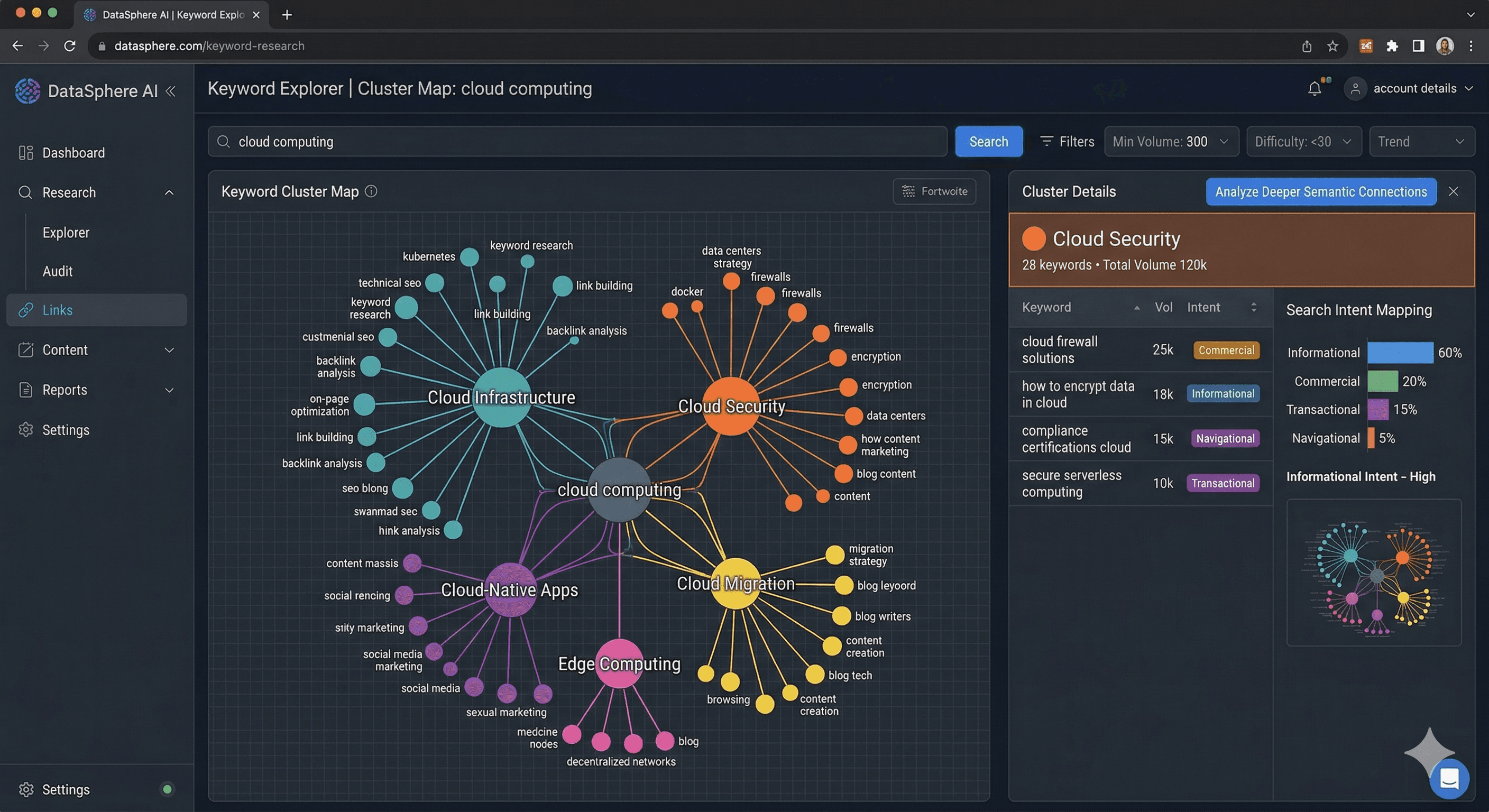
AI transforms keyword research from a data collection exercise into a deep intent-mapping process. Instead of simply identifying high-volume terms, AI tools analyze search behavior patterns, semantic relationships, and even emerging queries before they trend — giving you a first-mover advantage.
How AI Changes the Game
Modern AI SEO tools don't just show you what people are searching for. They tell you why — and what kind of content will best satisfy that intent. They cluster related keywords automatically, map them to buyer journey stages, and predict which terms are gaining momentum.
According to a 2025 BrightEdge report, marketers using AI for keyword research saw a 34% improvement in organic click-through rates compared to those using manual methods alone.
Real-World Use Case
A SaaS company used Ahrefs' AI keyword suggestions combined with Frase.io's topic clustering to identify a cluster of 40 long-tail keywords around "project management for remote teams." By creating targeted content around this cluster, they grew organic traffic by 112% in six months.
Top AI Tools for Keyword Research
Ahrefs — AI-powered keyword clustering and intent analysis
SEMrush — Keyword Magic Tool with AI suggestions and trend data
Frase.io — Semantic keyword grouping and SERP analysis
Google Gemini + Search Console — Identifying intent patterns from real search data
Surfer SEO — NLP-driven keyword recommendations based on top-ranking pages
Actionable Tips
Use AI to group keywords by search intent (informational, navigational, transactional) rather than just volume.
Look for low-competition, high-intent long-tail keywords that AI tools surface from real-time SERP data.
Use AI-generated topic clusters to plan content hubs, not isolated blog posts.
Regularly re-audit your keyword strategy — AI tools can spot intent shifts faster than any manual process.
2. AI Content Creation and Optimization
The Content Volume vs. Quality Debate — Solved
One of the oldest arguments in SEO — quantity vs. quality — has been resolved by AI. With the right approach, AI enables you to produce high-quality content at scale without sacrificing depth, accuracy, or E-E-A-T signals.
Google's 2025 Helpful Content Update reinforced that content must demonstrate real experience and expertise, not just keyword optimization. AI tools, used correctly, help writers research faster, structure better, and optimize more effectively — while leaving the human insight and experience intact.
How AI Optimizes Your Content
AI content tools analyze the top 10–20 ranking pages for any keyword and extract the topics, questions, headings, and semantic terms that Google rewards. This means your content is built on what's already proven to work, then enhanced with original insights.
Real-World Use Case
A digital marketing agency used Jasper AI for first drafts and Surfer SEO for content scoring. By pairing AI-generated structure with human editorial oversight, they reduced content production time by 60% while increasing average content scores from 62 to 84 — leading to a 47% lift in organic impressions over three months.
Top AI Tools for Content Creation
Jasper AI — Long-form content generation with brand voice customization
Surfer SEO — Real-time content optimization scoring against SERP data
ChatGPT (GPT-4o / GPT-5) — Research, outline creation, and draft generation
Copy.ai — Marketing-focused content for meta tags, CTAs, and ad copy
Frase.io — AI writing combined with SERP-driven research briefs
Clearscope — NLP-powered content grading and term recommendations
Actionable Tips
Never publish raw AI output. Use AI for structure and research, then add your own expertise, data, and voice.
Always run content through a content scoring tool (Surfer, Clearscope) before publishing.
Include first-person experience, original case studies, and expert quotes to satisfy E-E-A-T.
Use AI to generate content briefs for your writing team, not just finished articles.
3. Technical SEO Audits with AI
Technical SEO: Powerful but Time-Consuming
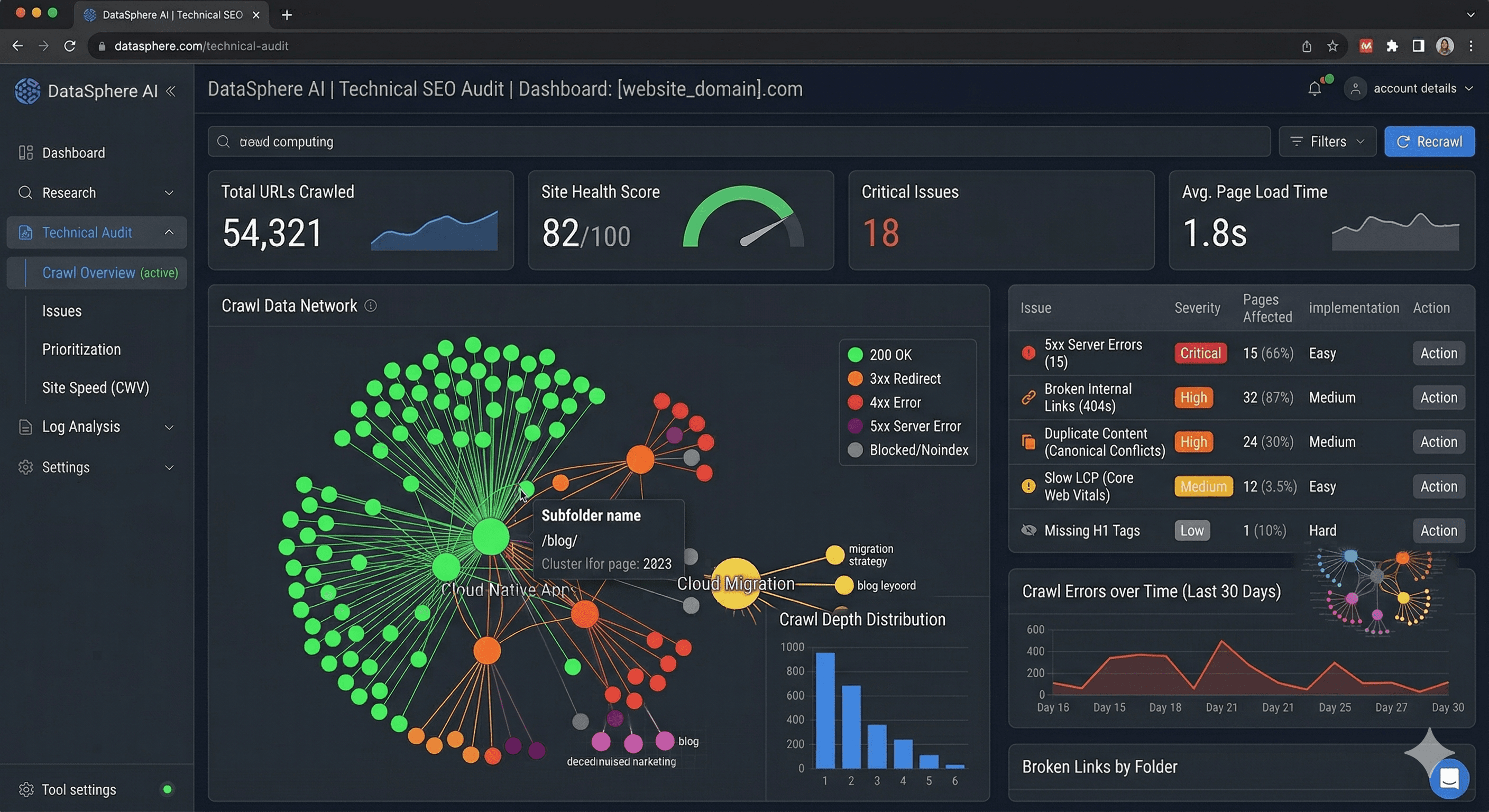
Crawling thousands of URLs, identifying broken links, flagging duplicate content, diagnosing Core Web Vitals issues — technical SEO audits are critical but brutally time-intensive when done manually.
AI-powered audit tools now do in minutes what used to take days. More importantly, they don't just flag problems. They prioritize them by impact and suggest fixes in plain language.
How AI Accelerates Technical SEO
AI audit platforms use machine learning to understand which technical issues are most likely to suppress rankings for your specific site and niche. They identify patterns across thousands of similar sites to give context-aware recommendations — not just a generic list of errors.
Real-World Use Case
An e-commerce retailer with 15,000 product pages used Screaming Frog integrated with SEMrush's Site Audit AI to identify 2,300 pages with duplicate title tags, 400+ broken internal links, and Core Web Vitals failures on mobile. AI prioritization showed that fixing the CWV issues on the top 200 product pages would have the greatest ranking impact. After resolving them, the site saw a 23% improvement in mobile rankings within eight weeks.
Top AI Tools for Technical SEO Audits
SEMrush Site Audit — AI-driven issue prioritization and health scoring
Ahrefs Site Audit — Comprehensive crawl with actionable fix suggestions
Screaming Frog + AI integrations — Deep technical crawls with AI-assisted analysis
Sitebulb — Visual crawl data with AI-powered insights
Google Search Console + Gemini AI — Native insights from Google on indexing and performance issues
Actionable Tips
Schedule automated monthly audits with AI tools — don't wait for rankings to drop.
Focus AI audit outputs on Core Web Vitals, crawlability, and schema markup first.
Use AI to generate developer tickets directly from audit findings to close the gap between SEO and dev teams.
Monitor log file analysis with AI to understand how Googlebot is actually crawling your site.
4. AI for On-Page SEO Optimization
On-Page SEO Is More Nuanced Than Ever
Title tags and meta descriptions are just the beginning. On-page SEO in 2026 encompasses semantic relevance, entity optimization, structured data, internal linking architecture, and content depth — all of which AI can help you manage at scale.
Google's NLP-driven ranking systems (like MUM and Gemini) understand content far beyond simple keyword matching. Your on-page signals need to match this sophistication.
What AI Does for On-Page SEO
AI tools analyze your existing pages against top competitors and surface specific, actionable improvements — whether that's adding a missing entity, restructuring your H2s, improving your schema markup, or expanding a thin section of content.
Real-World Use Case
A B2B software company used Surfer SEO's Audit feature on 50 of their service pages. The AI identified that their pages lacked coverage of several related semantic entities that competitors consistently included. After updating the pages based on AI recommendations, 31 of the 50 pages moved up in rankings within 60 days.
Top AI Tools for On-Page SEO
Surfer SEO — Page-by-page content audit with NLP-based recommendations
Clearscope — Semantic term grading and content depth analysis
SEMrush On-Page SEO Checker — AI-powered actionable suggestions per page
Alli AI — Automated on-page changes at scale for large sites
ChatGPT — Rewriting meta titles, descriptions, and header structures
Actionable Tips
Optimize for entities and topics, not just keywords. AI tools surface the entities Google expects to see on a page about a given topic.
Use AI to audit your internal linking structure — link equity distribution is often overlooked.
Let AI generate and validate your schema markup (FAQ, HowTo, Product, Article schemas) to improve rich snippet eligibility.
Revisit your top 20 pages every quarter with an AI on-page audit.
5. AI-Driven Competitor Analysis
Know Your Competitors Better Than They Know Themselves
Competitor analysis used to mean manually reading through rival websites, guessing at their strategies, and hoping you'd spotted the right patterns. AI compresses this from weeks of research into hours — and surfaces insights you'd likely never find manually.
What AI Reveals About Competitors
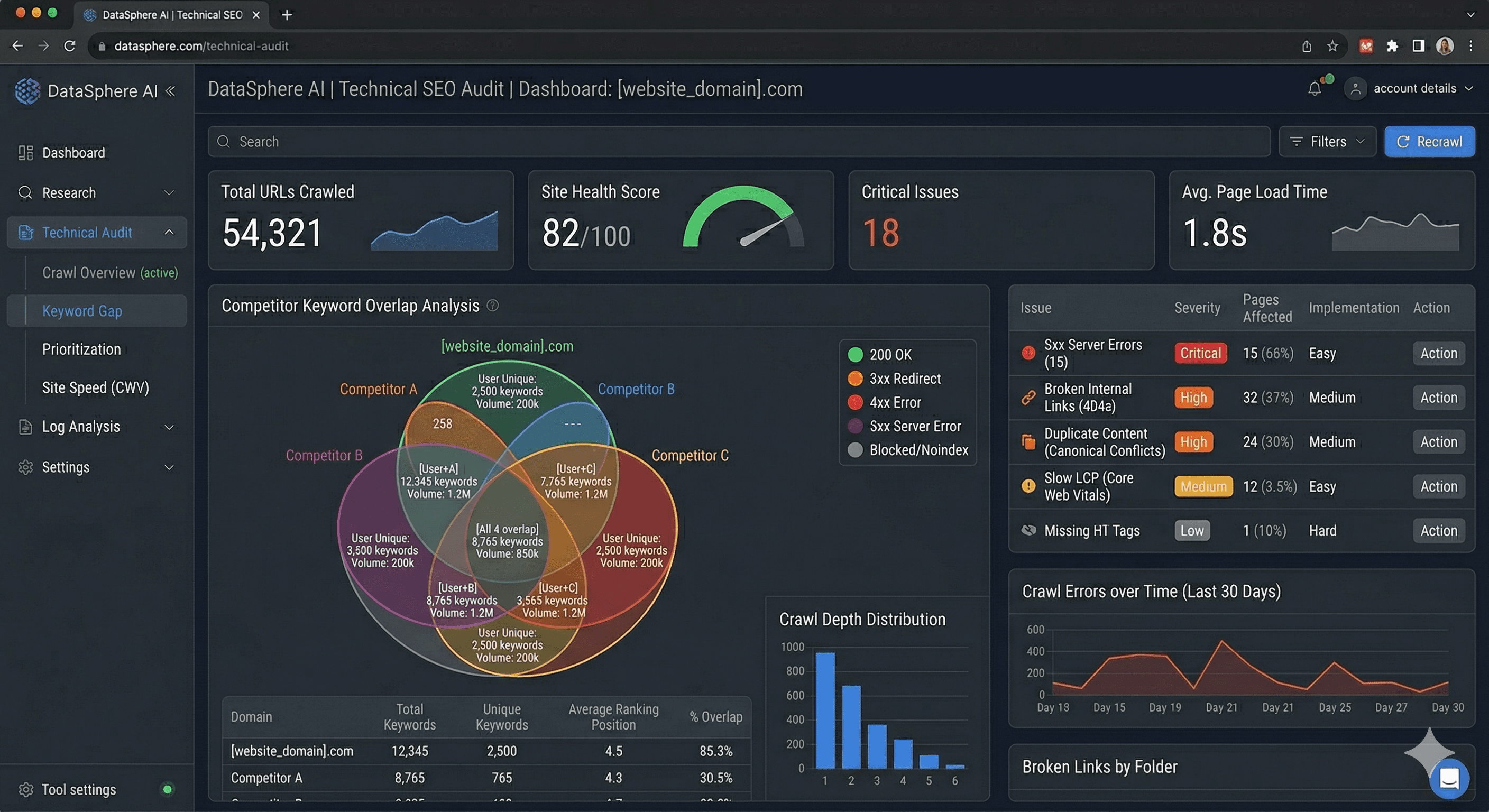
AI-powered competitive intelligence tools reverse-engineer your competitors' SEO strategies: which keywords they're targeting, which pages earn the most backlinks, how their content is structured, what topics they're ignoring, and where their rankings are declining (your opportunity).
Real-World Use Case
A travel blog used Ahrefs' Content Gap feature to identify 300+ keywords that the top 5 competitors in their niche ranked for — but their site didn't target at all. AI clustering grouped these into 12 content topic hubs. Publishing three hub articles per month, they closed the gap significantly within a year and doubled their organic sessions.
Top AI Tools for Competitor Analysis
Ahrefs — Content gap analysis, backlink comparison, and competitor keyword tracking
SEMrush — Competitive positioning maps and traffic analytics
SpyFu — Historical competitor keyword and ad data
SimilarWeb — Traffic source and engagement benchmarking
BrightEdge — AI-driven share-of-voice tracking across competitors
Actionable Tips
Use AI to find content gaps — topics competitors rank for that you don't cover yet.
Track competitor backlink velocity to understand when they're in link-building campaigns.
Identify competitors' declining content — these are opportunities to create superior, updated resources.
Set up AI-powered rank tracking alerts to get notified when competitors move significantly in the SERPs.
6. Automated Link Building with AI
Link Building in 2026: Smarter, Not Harder
Backlinks remain one of Google's top ranking factors. But the era of mass outreach with templated emails is over. Google's spam detection is more sophisticated than ever, and only relevant, editorial, high-authority links move the needle.
AI makes link building smarter by identifying the right prospects, personalizing outreach, and predicting which link opportunities will have the most ranking impact.
How AI Transforms Link Building
AI tools analyze your existing backlink profile, identify gaps compared to competitors, score prospects by topical relevance and domain authority, and even assist in crafting personalized outreach emails at scale — without making them feel templated.
Real-World Use Case
A financial advisory firm used Pitchbox with AI personalization combined with Ahrefs' link intersect tool to identify 180 relevant prospect sites. Their AI-assisted outreach had a 22% response rate (vs. an industry average of 5–8%), and they built 34 high-quality backlinks in 90 days — improving their domain authority by 11 points.
Top AI Tools for Link Building
Pitchbox — AI-personalized outreach automation and prospect management
Respona — AI-powered email personalization for link building campaigns
Ahrefs — Backlink gap and link intersect analysis
SEMrush Link Building Tool — Prospect scoring and outreach tracking
Hunter.io — AI-assisted contact finding for outreach targets
Actionable Tips
Use AI to score link prospects by topical relevance, not just domain authority alone.
AI-personalize your outreach emails by referencing specific content on the prospect's site.
Focus on digital PR opportunities — AI tools can identify journalists and publications covering your topics.
Regularly audit your toxic backlink profile with AI and disavow harmful links proactively.
7. AI for Local SEO
Local Search Is Fiercely Competitive — AI Is Your Edge
With "near me" searches growing year-over-year and Google's local pack dominating mobile search results, local SEO has become one of the highest-ROI channels for businesses with physical locations or service areas.
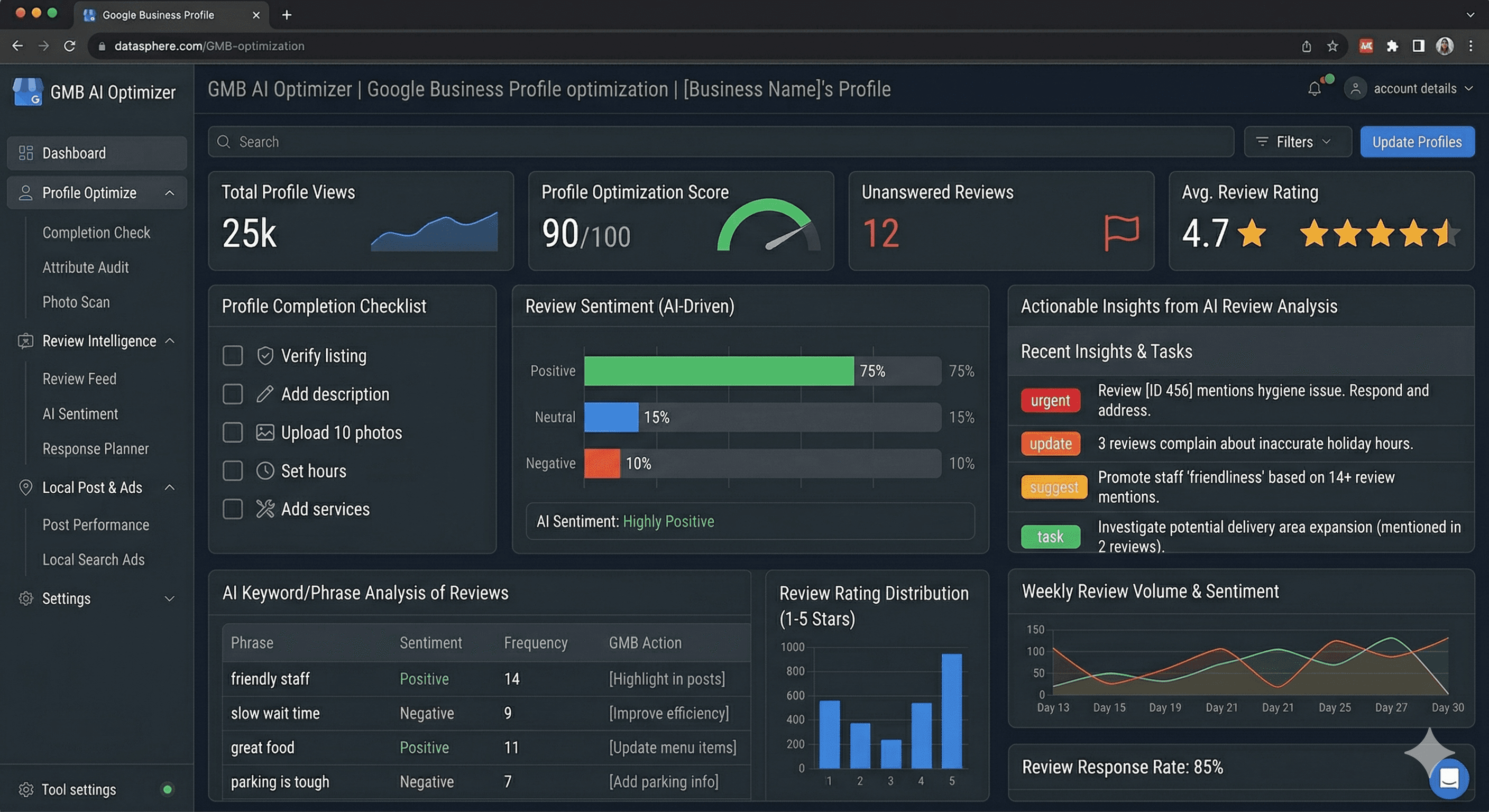
AI tools help local businesses optimize their Google Business Profiles, manage reviews at scale, identify local keyword opportunities, and monitor local SERP volatility more effectively than any manual approach.
How AI Powers Local SEO
AI analyzes local SERP patterns, identifies which GBP categories, attributes, and content formats perform best in your area and niche, and helps you spot review sentiment issues before they damage your reputation.
Real-World Use Case
A multi-location dental practice chain used BrightLocal's AI review analysis combined with Whitespark's local citation AI to identify inconsistencies across 12 locations, optimize their GBP categories, and respond to 400+ reviews in a brand-consistent way. Local pack rankings improved for 9 of 12 locations within three months.
Top AI Tools for Local SEO
BrightLocal — Local rank tracking, citation auditing, and review management with AI insights
Whitespark — Citation building and local competitive analysis
Semrush Local — AI-powered local keyword research and GBP optimization
Podium — AI-assisted review generation and response management
ChatGPT — Generating localized content, FAQs, and GBP posts at scale
Actionable Tips
Use AI to audit citation consistency across all directories — NAP inconsistencies hurt local rankings.
Generate localized content (neighborhood guides, local FAQs) using AI to target hyper-local keywords.
Use AI to analyze review sentiment and identify recurring complaint themes before they escalate.
Optimize GBP posts weekly using AI-generated, keyword-rich updates.
8. AI and Voice Search Optimization
Voice Search Is Mainstream — Are You Optimizing for It?
By 2026, an estimated 58% of consumers use voice search to find local business information (ComScore). With smart speakers, in-car AI assistants, and mobile voice queries becoming habitual, voice search optimization is no longer a niche tactic.
Voice queries are fundamentally different from typed searches — they're longer, more conversational, and often framed as questions. AI tools help you understand and optimize for this shift.
How AI Optimizes for Voice Search
AI identifies the natural language questions users ask around your topics, helps you structure content to directly answer those questions (ideal for featured snippets — the primary source for voice answers), and optimizes for the conversational tone that voice search rewards.
Real-World Use Case
A home improvement brand restructured 80 blog posts using Frase.io's AI question research to target conversational, question-based queries. Within four months, 23 of those posts were earning featured snippets, and voice-driven traffic (measured via Google Search Console's query filters) increased by 41%.
Top AI Tools for Voice Search Optimization
Frase.io — Question-based content research and optimization
AnswerThePublic (by Ubersuggest) — Visual maps of voice and question queries
SEMrush Position Tracking — Monitoring featured snippet ownership
AlsoAsked.com — AI-assisted "People Also Ask" research
ChatGPT — Rewriting content in conversational, question-answer format
Actionable Tips
Structure content with direct, concise answers (40–60 words) immediately following each question heading.
Target long-tail, conversational queries that mirror how people speak, not just how they type.
Implement FAQ schema markup to increase your chance of earning featured snippets and voice answers.
Focus on local voice queries ("best pizza near me open now") for location-based businesses.
9. AI for Predictive SEO and Trend Forecasting
Get Ahead of the Curve with Predictive Intelligence
Reactive SEO — waiting for trends to peak before creating content — means you're always competing in a crowded space. Predictive SEO, powered by AI, lets you identify trends before they fully emerge and position your content as the authority when traffic surges.
This is one of the most underutilized AI SEO strategies, and it can be a genuine competitive differentiator.
How Predictive AI Works in SEO
AI models analyze search trend data, social signals, news cycles, seasonal patterns, and industry forums to identify topics that are gaining momentum — often 3–6 months before they become mainstream search terms. You create the content now; you rank when the traffic arrives.
Real-World Use Case
A fintech blog used Google Trends AI analysis combined with BrightEdge's Data Cube to identify rising interest in "embedded finance for small businesses" six months before it became a widely searched topic. Their comprehensive guide ranked on page one before competitors had even started writing about it, capturing over 18,000 monthly visits at the topic's peak.
Top AI Tools for Predictive SEO
BrightEdge — AI-powered trend detection and content performance forecasting
Google Trends — Free trend data, especially powerful with AI analysis layered on top
Exploding Topics — AI-curated emerging trend discovery
SEMrush Sensor — SERP volatility tracking and trend alerts
SparkToro — Audience intelligence to understand what your market is discussing
Actionable Tips
Pair Exploding Topics with a keyword research tool to validate search volume potential for emerging trends.
Build a content pipeline for predicted trends 2–3 months in advance of expected peak search volume.
Monitor Reddit, Quora, and industry forums using AI summarization tools to spot organic trend signals.
Use AI to forecast seasonal SEO opportunities and schedule content production accordingly.
10. AI in SGE and Zero-Click Search Optimization
The Biggest SEO Shift of the Decade
Google's Search Generative Experience (SGE) — now deeply embedded across Google Search in 2026 — is arguably the most disruptive force in SEO history. AI-generated answer panels appear above organic results for a growing percentage of queries, fundamentally changing how (and whether) users click through to websites.
Zero-click searches — where users get their answer directly from the SERP without visiting any site — now account for over 60% of all Google searches (SparkToro, 2025). Ignoring this trend is simply not an option.
What SGE Means for Your SEO Strategy
The brands that win in an SGE-dominant world are those that provide clear, structured, authoritative, and citable content. Google's AI pulls content from trusted sources to build its generated answers — your goal is to be one of those sources.
How AI Helps You Optimize for SGE
AI tools help you structure content in SGE-friendly formats: direct answers, clear definitions, numbered processes, comparison tables, and expert statements. They also help you build E-E-A-T signals that make Google more likely to cite your content in generated responses.
Real-World Use Case
A healthcare information website restructured 120 key articles using AI-assisted content optimization focused on SGE readiness — clear definitions in the opening paragraph, structured step-by-step processes, and verified expert citations. Within five months, 38 of those pages were being cited in SGE answer panels, increasing brand impressions by over 200% even as direct click traffic shifted.
Strategies for SGE and Zero-Click Optimization
Become a cited source, not just a ranking result:
Structure content so the first 100 words directly answer the primary query.
Use definition boxes, numbered lists, and comparison tables — these are SGE-friendly formats.
Build author authority pages with credentials, bylines, and external mentions to strengthen E-E-A-T.
Capture value beyond the click:
Optimize for brand visibility — even if SGE reduces clicks, appearing in AI answers builds brand recall.
Double down on transactional and commercial intent queries — users with buying intent are more likely to click through despite SGE.
Focus on unique data, original research, and proprietary insights — Google's AI can't synthesize what doesn't exist anywhere else.
Top AI Tools for SGE Optimization
Surfer SEO — SGE-readiness content scoring
ChatGPT / Gemini — Restructuring content for direct-answer formats
Schema App — Advanced structured data implementation
Frase.io — Content briefs optimized for featured snippets and AI answers
MarketMuse — Topical authority building at scale
Actionable Tips
Monitor which of your current featured snippet pages are being absorbed into SGE panels and adapt your strategy.
Invest in original research and data — AI-generated answers can't cite statistics that don't exist elsewhere.
Use structured data (FAQ, HowTo, Article schema) to make your content machine-readable for AI systems.
Build your brand as an entity in Google's Knowledge Graph through consistent mentions, Wikipedia references, and authoritative external citations.
🎓 Ready to Master AI SEO?
The future of digital success belongs to businesses that combine smart strategy with AI-driven execution. At IndianSEOAgency (ISEOA) — India’s best SEO services provider — we deliver cutting-edge AI SEO solutions designed to boost your rankings, traffic, and conversions.
✅ Data-driven SEO strategies powered by AI
✅ Experienced SEO experts with proven results
✅ Customized solutions for every business niche
✅ Transparent reporting & measurable growthPartner with ISEOA and take your online presence to the next level in 2026 🚀
Frequently Asked Questions
Q1: What is AI in SEO and how does it work?
AI in SEO refers to the use of artificial intelligence technologies — including machine learning, natural language processing, and predictive analytics — to improve search engine optimization processes. AI tools analyze vast amounts of data to automate keyword research, generate and optimize content, audit technical issues, predict trends, and identify link building opportunities, all faster and more accurately than manual methods.
Q2: Which AI SEO tools are best for beginners in 2026?
For beginners, Surfer SEO (content optimization), Frase.io (research and writing), and SEMrush (all-in-one SEO with AI features) offer the most user-friendly interfaces with strong AI capabilities. ChatGPT is also invaluable for generating content outlines, meta tags, and topic ideas.
Q3: Will AI replace SEO professionals?
No — AI augments SEO professionals rather than replacing them. AI handles data-heavy, repetitive tasks faster and more accurately than humans, but it lacks the strategic thinking, creativity, brand knowledge, and client relationship management that define excellent SEO work. The demand is shifting toward SEO professionals who are skilled at using AI tools effectively.
Q4: How does AI help with Google's Search Generative Experience (SGE)?
AI tools help you structure content in SGE-friendly formats — direct answers, clear definitions, structured lists, and comparison tables — that Google's AI is more likely to cite in generated responses. They also help build the E-E-A-T signals (expertise, experience, authority, and trustworthiness) that make your site a preferred source for SGE content.
Q5: Is AI-generated content safe to use for SEO?
AI-generated content is safe when it meets Google's quality standards — meaning it provides genuine value, demonstrates expertise, and doesn't appear to be mass-produced spam. Google's guidelines focus on content quality and helpfulness, not the tool used to create it. Always review, fact-check, and enhance AI-drafted content with original insights before publishing.
Q6: How much can AI improve my SEO results?
Results vary by industry, competition, and implementation quality, but research consistently shows significant gains. BrightEdge reports that companies using AI-powered SEO see an average of 30–40% improvement in organic traffic within 12 months. The biggest gains come from consistent implementation across keyword research, content optimization, and technical SEO.
Q7: What is the biggest risk of using AI in SEO?
The biggest risk is over-automation without human oversight — publishing low-quality AI content at scale, which can trigger Google penalties and damage E-E-A-T signals. AI should be treated as a powerful tool that accelerates and enhances human-led strategy, not a replacement for genuine expertise and quality control.
Conclusion
AI in SEO has moved from experimental to essential. In 2026, the question is no longer whether to use AI tools — it's how to use them strategically to stay ahead of the competition.
Across every dimension of SEO — from keyword research to content creation, technical audits to voice search, and competitor analysis to SGE optimization — AI tools deliver faster insights, smarter automation, and better results than any manual-only approach.
Key Takeaways
AI-powered keyword research uncovers intent, not just volume — mapping your content to what users actually need.
AI content tools accelerate production without compromising quality when combined with human expertise.
Technical SEO audits become proactive rather than reactive with AI prioritization.
Predictive SEO lets you capture traffic before trends peak — a genuine competitive advantage.
SGE optimization requires structured, authoritative, entity-rich content — and AI helps you build exactly that.
The businesses winning in search today are those treating AI as a strategic amplifier of human expertise, not a shortcut around it. Apply the strategies in this guide consistently, measure your results, and keep learning as the technology evolves.
Search is changing fast. With AI in your toolkit, you're ready for whatever comes next.
🚀 Start Your AI SEO Journey Today
Whether you're looking to upskill yourself or grow your business's organic presence, IndianSEOAgency (ISEOA) has the resources, courses, and community to help you succeed.
📩 Get a Free AI SEO Strategy Consultation →
Suggested External Authority Links (Placeholders)
Written by a certified digital marketing strategist with 8+ years of SEO experience across B2B, e-commerce, and local business sectors. All statistics referenced from publicly available industry research published in 2024–2025.
© 2026 IndianSEOAgency (ISEOA) | All rights reserved. This article is original content created for educational and marketing purposes.